Can You Visit Yellowstone Without a Car?
Yellowstone covers 2.2 million acres across three states, with 142 miles of Grand Loop Road connecting its major attractions. There is no public transit inside the park. So can you realistically visit without your own car? Yes, but only if you plan around the options that exist.
Choose the trip that fits your gateway, available time and actual party needs.
Booking choice: Old Faithful, Grand Prismatic and Canyon with a guide, lunch and binoculars. Up to 13 hours with travel; moderate walking. Select Jackson/Teton pickup points. Confirm park fees for your residency.
Explore Jackson Lower Loop day tourWe may earn a commission when you book through these links.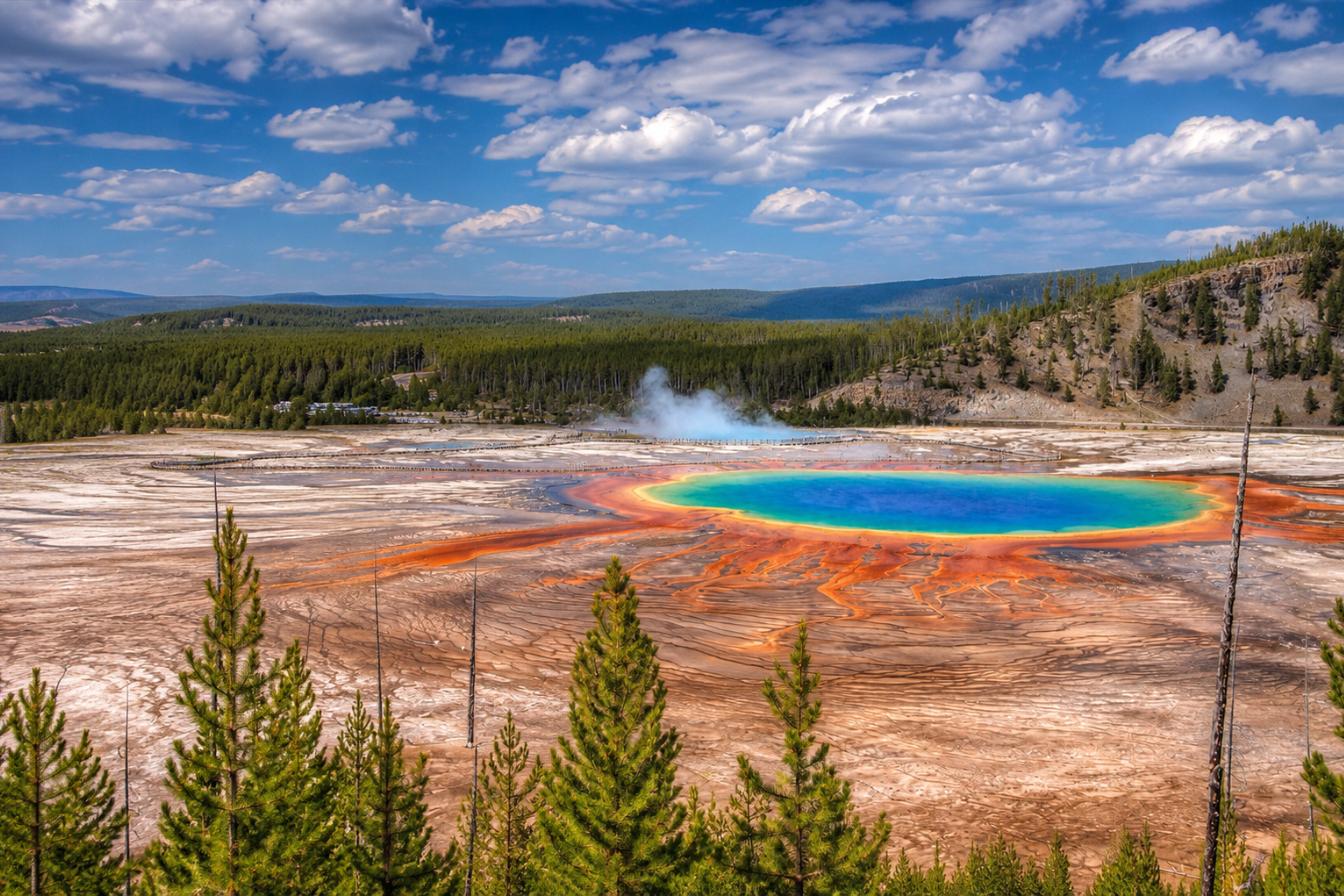
Why is a car the default?
Yellowstone was built for cars. The Grand Loop Road is the spine of the park, and nearly every major attraction, from Old Faithful to the Lamar Valley, sits along it. There is no rail service to or inside the park, no city-style bus network, and no ride-share coverage once you pass the gateway towns. The distances between attractions are large: Old Faithful to Canyon Village is 39 miles, Canyon Village to Mammoth Hot Springs is 36 miles, and the full Grand Loop is 142 miles. Without wheels of some kind, you are stuck at whatever point you arrived.
This is the reality that makes the question worth answering honestly. You can visit Yellowstone without a car, but not the same way you visit a national park with a shuttle system like Zion or a train line like the Swiss Alps. The alternatives require advance planning, and most of them mean joining a guided group rather than wandering on your own schedule.
Option 1: Guided tour packages (the most practical solution)
A multi-day guided tour is the most practical and complete way to see Yellowstone without a car. Tours pick you up in a gateway city, drive you through the park in a vehicle with a guide, cover both the Upper and Lower Loops across multiple days, and drop you back at your starting point. You never need a car, never need to navigate, and never need to find parking at a trailhead.
Several formats exist depending on where you are starting from and what you want to spend.
| Tour format | Starting city | Duration | Price from | What's included |
|---|---|---|---|---|
| 4-day camping tour | Salt Lake City | 4 days | $1,050 | Camping gear, meals, park entry, small group (14 max) |
| 4-day wildlife safari | Jackson Hole | 4 days | $2,198 | Hotel stays, naturalist guide, binoculars and spotting scope, ages 6+ |
| 5-day hotel-based tour | Bozeman to Jackson | 5 days | $2,995 | Hotel stays, wolf tracking, small group (13 max) |
| 6-day camping and rafting | Jackson Hole | 6 days | $2,159 | Camping, meals, whitewater rafting, ages 12+ |
| 7-day luxury coach | Bozeman to Jackson | 7 days | $6,012 | Premium hotels, coach transport and specified meals |
The 4-day camping tour from Salt Lake City is particularly useful for visitors without a car because Salt Lake City has a major international airport with frequent service, and the tour handles all transportation from there. You fly in, get picked up, spend four days in Yellowstone and Grand Teton, and fly home. No rental car needed at any stage. See the full list of Yellowstone guided tours to compare all available options.
Option 2: Gateway-town shuttles and seasonal park transit
Some gateway towns offer seasonal shuttle services that can get you into the park, though coverage is limited compared to a guided tour.
West Yellowstone is the busiest gateway and occasionally offers shuttle services to Old Faithful and Madison Junction during peak summer months. These services change year to year, so checking with the West Yellowstone Chamber of Commerce before your trip is a must.
Gardiner, at the park's north entrance, is small enough to walk around and sits right at the park boundary. You can enter through the Roosevelt Arch on foot, but getting from the north entrance to Mammoth Hot Springs (5 miles) and beyond still requires a vehicle of some kind.
Jackson Hole has stronger transportation infrastructure, including airport shuttles and seasonal transit options, but it sits 57 miles south of Yellowstone's South Entrance. Several Yellowstone tours from Jackson Hole bridge this gap with daily and multi-day departures that include the drive in.
The park itself has experimented with pilot shuttle programs in recent years, particularly around the Old Faithful area during peak congestion. These are not yet reliable enough to plan a trip around, but they signal that the Park Service recognizes the car-dependency problem. Check the NPS website for current-year shuttle availability before building your itinerary around public transit inside the park.
Option 3: Fly in and combine airport + tour
The three nearest airports each connect to tour pickup points without requiring a rental car.
| Airport | Code | Distance to park | Tour connections |
|---|---|---|---|
| Jackson Hole Airport | JAC | Inside Grand Teton NP, 57 miles to Yellowstone's South Entrance | Multiple tours depart from Jackson; some pick up at the airport directly |
| Bozeman Yellowstone International | BZN | 90 miles to park's north entrance at Gardiner | Tours departing from Bozeman include transport; largest airport in the region |
| West Yellowstone Airport | WYS | Adjacent to West Entrance | Small, seasonal airport; some tours depart from West Yellowstone |
Bozeman is the most practical fly-in option for carless visitors because it has the most flight connections (including direct flights from major hubs) and serves as the starting point for several multi-day tours. The 5-day hotel-based tour departs from Bozeman and ends in Jackson, so you could fly into Bozeman and out of Jackson without backtracking. A similar breakdown for each gateway is in the tours from Bozeman guide.
What you will miss without a car
Honesty matters here. A guided tour covers the major highlights, both loops, the big geysers, the major wildlife valleys, the canyon viewpoints. But it does not give you the same flexibility a car does. You cannot pull over at a random meadow because a coyote caught your eye. You cannot stay an extra hour at the Lamar Valley because the wolves showed up late. You cannot drive to a remote trailhead at 5:00 AM for a backcountry hike.
If your priority is ticking off the major sights and getting expert interpretation of what you see, a guided tour without a car is a better experience than a self-drive trip for many visitors. If your priority is freedom, spontaneity and backcountry access, you need a car. The Yellowstone tour vs self-drive comparison lays out both sides in detail.
Can you bike Yellowstone?
Technically, yes. Cycling is allowed on all park roads and some designated trails. In practice, Yellowstone's roads were not designed for bicycles: there are no separated bike lanes, the shoulders are narrow or nonexistent in many stretches, traffic includes RVs and tour buses, and the distances between services are long (30-40 miles in some cases). A handful of experienced long-distance cyclists ride the Grand Loop each year, but this is an endurance challenge, not a casual sightseeing option.
That said, the park occasionally closes certain roads to cars in early spring before the full season opens, creating windows where cyclists can ride on empty pavement. These closures are published on the NPS website each spring. For most visitors, cycling is an option for short stretches near gateway towns, not a substitute for a car or a tour through the full park.