Yellowstone Itinerary: 3-Day, 4-Day and 5-Day Plans
Yellowstone sprawls across 2.2 million acres, and most first-time visitors underestimate how much driving sits between the major sights. A three-day trip covers the thermal highlights and one or two wildlife corridors. Four days lets you breathe. Five days opens the door to Grand Teton, a river float and the kind of slow mornings where you actually watch a wolf pack without checking the clock.
Choose the trip that fits your gateway, available time and actual party needs.
Booking choice: Two days connect the geysers, Canyon, Mammoth and Lamar Valley with a guide and optics. Lodging, breakfast, dinner and park entry are extra. Arrange the overnight accommodation with the operator. Not recommended for poor cardiovascular health.
Explore Two-day Upper and Lower Loop tourWe may earn a commission when you book through these links.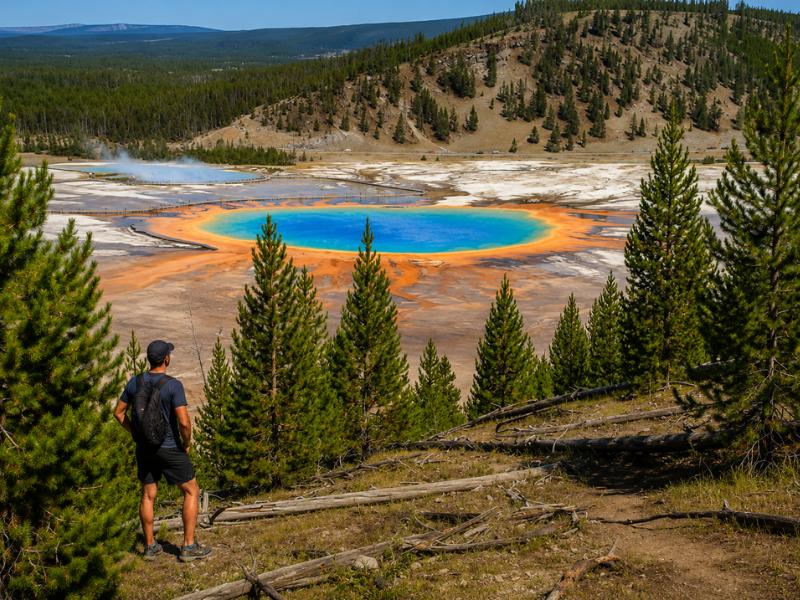
How many days do you actually need in Yellowstone?
Three days is the realistic minimum to see Old Faithful, Grand Prismatic Spring, the Grand Canyon of the Yellowstone and at least one wildlife-rich valley. Four days removes the rush and adds a second early-morning wildlife session. Five days lets you fold in Grand Teton National Park and a full rest day. Anything shorter than three days means choosing between geysers and wildlife rather than experiencing both.
The park's Grand Loop Road alone covers 142 miles, and most of the marquee sights sit on different segments of that loop. Driving between Old Faithful and the Lamar Valley takes roughly two and a half hours with no stops, so every itinerary is partly a logistics puzzle: which clusters of sights sit close enough together to fill a day without spending it all behind the windshield?
The table below maps trip length to what you can realistically cover, assuming you enter the park early each morning and leave late each evening, which is the pattern every experienced Yellowstone visitor follows for both wildlife and crowd avoidance.
| Trip length | What you can cover | What you miss | Pace |
|---|---|---|---|
| 3 days | Old Faithful, Grand Prismatic, Upper and Lower Geyser Basins, Grand Canyon of the Yellowstone, one morning in Hayden or Lamar Valley | Grand Teton, deep Lamar Valley wildlife sessions, most backcountry hikes, Mammoth Hot Springs | Tight. Every hour is scheduled. |
| 4 days | Everything above plus Mammoth Hot Springs, two Lamar Valley sessions, Norris Geyser Basin, a longer hike (Mt. Washburn or Fairy Falls) | Grand Teton, whitewater rafting, extended backcountry | Comfortable. One slow morning built in. |
| 5 days | Full Yellowstone loop plus Grand Teton, Snake River float, possible sunrise from Signal Mountain or Schwabacher Landing | Multi-day backcountry permits, remote corners like Bechler or Thorofare | Relaxed. Room for a weather buffer day. |
That progression matters when you're deciding between a self-drive trip and a guided tour. Guided multi-day packages compress the logistics: a naturalist guide who knows which Lamar Valley pullout to hit at 6:15 a.m. and which boardwalk to skip when crowds peak at noon saves at least an hour a day compared to a first-timer finding their way by map. The operators we work with run itineraries at each of these lengths, and the differences between them go well beyond "more days, same stuff." Each extra day shifts what kind of trip it becomes.
For a deeper look at the time-versus-coverage tradeoff, see how many days you need in Yellowstone.
What does a 3-day Yellowstone itinerary look like?
A 3-day itinerary splits the park into three geographic zones: the Upper and Lower Geyser Basins on day one, the Grand Canyon of the Yellowstone and Hayden Valley on day two, and Mammoth Hot Springs plus a Lamar Valley wildlife drive on day three. This is the most common pattern for first-time visitors driving themselves, and it works if you accept that every day starts before sunrise and ends after dark.
| Day | Focus area | Key stops | Driving (approx.) |
|---|---|---|---|
| 1 | Geyser country (west side) | Old Faithful, Grand Prismatic Spring, Fountain Paint Pot and Firehole River viewpoints; verify current access before travel | 30-40 miles within the basin area |
| 2 | Canyon and central Yellowstone | Upper and Lower Falls viewpoints, Artist Point, Hayden Valley wildlife drive and Mud Volcano; verify trail access | 50-60 miles |
| 3 | Northern range and wildlife | Mammoth Hot Springs terraces, Tower Fall, Lamar Valley early-morning wildlife drive, Petrified Tree | 80-100 miles if entering from the south |
The hardest decision on a 3-day trip is whether to give Lamar Valley a full morning or squeeze it into an afternoon. Morning wins every time for wildlife. Bison herds are active at dawn, wolf packs are most visible in the first and last hour of daylight, and the crowds that clog pullouts by 10 a.m. haven't arrived yet. If you only have one shot at Lamar, take the early one.
Three days is tight enough that weather can wreck a plan. A thunderstorm over Canyon Village at midday pushes the falls viewpoint to the next morning, which cascades into everything else. Building a "priority stack" helps: decide in advance which two sights matter most to you, and protect those slots. Everything else is flexible.
Self-driving a 3-day itinerary means handling your own lodging, food and route planning inside a park where cell service is intermittent at best. If you'd rather hand that to someone who knows the roads, the 4-day Yellowstone and Grand Tetons camping tour from Salt Lake City covers comparable ground in a slightly more relaxed four-day frame, with transport from Salt Lake City, camping gear provided (except sleeping bags) and a guide who adjusts the route based on real-time wildlife sightings. At around $1,050 per person with a 4.9 rating across 429+ bookings on TourRadar, it's one of the most accessible ways to cover the core loop without planning every mile yourself.
What does a 4-day Yellowstone itinerary look like?
Four days follows the same geographic logic as three, but adds a full day for Norris Geyser Basin, a longer hike, and a second dedicated wildlife session. The extra day shifts the trip from "checklist" mode to something closer to actual exploration. It also builds in one morning where you don't need to be somewhere specific by 6 a.m., which matters more than it sounds after three days of pre-dawn alarms.
| Day | Focus area | Key stops | What the extra time adds |
|---|---|---|---|
| 1 | Geyser basins | Old Faithful, Grand Prismatic overlook trail and an optional Lone Star Geyser hike if conditions permit | Lone Star Geyser: a backcountry geyser most 3-day visitors skip entirely |
| 2 | Canyon and Hayden Valley | Upper and Lower Falls, Artist Point, South Rim trail, Hayden Valley sunset drive | Sunset drive in Hayden Valley instead of rushing through at midday |
| 3 | Norris and Mammoth | Norris Geyser Basin and Mammoth Hot Springs terraces; do not plan a Boiling River soak | Full coverage of Norris, which most 3-day visitors skip or rush |
| 4 | Lamar Valley wildlife | Pre-dawn drive into Lamar, Slough Creek pullout, Pebble Creek, Tower Fall on the drive out | Dedicated full morning for wildlife without rushing to the next stop |
The 4-day frame is where guided tours start to show a clear advantage over self-driving. A naturalist guide doesn't just drive. They carry spotting scopes, know which meadow the wolf packs were using last week, and adjust the route on the fly. The 5-day Yellowstone and Grand Teton in-depth hotel-based tour runs a comparable Yellowstone loop across its first three days, with a wolf-tracking expert on the team, binoculars provided, and hotel lodging in gateway towns each night. At around $2,995 per person with a perfect 5.0 rating, it skews toward visitors who want wildlife depth over budget optimization.
One important logistical point for self-drivers: gas stations inside Yellowstone are limited to a handful of locations (Old Faithful, Canyon Village, Fishing Bridge, Mammoth, Tower Junction and Grant Village), and several close by early evening. Running out of gas in Lamar Valley at dusk is a real thing that happens to visitors who assume fuel will be available everywhere. Fill up every time you pass a station, regardless of how much you have left.
What does a 5-day Yellowstone itinerary look like?
Five days covers the full Yellowstone loop and adds Grand Teton National Park, typically as a day-long southward push on day four or five. This is the trip length where the Teton Range, Jenny Lake, the Snake River corridor and Jackson Hole come into play. It also leaves room for a rafting trip, a longer backcountry hike (Mt. Washburn at 6.2 miles round trip is the classic), or simply a rest morning after four days of early starts.
| Day | Focus area | Key stops |
|---|---|---|
| 1 | Geyser basins and thermal features | Old Faithful, Grand Prismatic, Fountain Paint Pot and Firehole River viewpoints |
| 2 | Canyon, Hayden Valley | Grand Canyon of the Yellowstone, Artist Point, Hayden Valley dawn wildlife drive |
| 3 | Northern range and wildlife | Lamar Valley pre-dawn session, Mammoth Hot Springs, Norris Geyser Basin |
| 4 | Grand Teton National Park | Jenny Lake, Schwabacher Landing sunrise, Signal Mountain summit, Moose Junction, Snake River overlook |
| 5 | Activity day or flex day | Whitewater rafting on the Snake River, Mt. Washburn hike, or revisit a favorite valley for wildlife |
The 5-day shape matches several guided tour packages almost exactly. The Yellowstone Camping Explorer by G Adventures runs a 6-day version of this arc that adds whitewater rafting and a Snake River float, both built into the itinerary rather than booked as extras. At around $2,159 per person with a 5.0 rating, it covers Yellowstone and Grand Teton with camping each night and meals handled by the guides. The age minimum is 12, making it better suited to older families or adult groups than the tours that accept children from age 6 or 7.
If your fifth day falls during summer (mid-June through August), the combination of Grand Teton plus a Snake River float makes that day the strongest single-day experience of the whole trip for most visitors. The Teton Range seen from the river at water level, with no road noise and no windshield between you and the peaks, is a different experience from anything Yellowstone itself offers. Several of the operators we work with include this float as a standard itinerary stop, not an optional add-on.
Which entrance should you use, and does it change by itinerary length?
The West Entrance (West Yellowstone, MT) is the most popular and the closest to Old Faithful, making it the best starting point for any itinerary that leads with geysers. The North Entrance (Gardiner, MT) is the only entrance open year-round and the best pick for winter or shoulder-season trips. The South Entrance connects directly to Grand Teton, so 5-day itineraries that end with the Tetons should plan to exit or enter there.
| Entrance | Gateway town | Open | Best for | Drive to Old Faithful |
|---|---|---|---|---|
| West | West Yellowstone, MT | Late April to early November | Geyser-first itineraries, most lodging options | ~30 miles / 45 min |
| North | Gardiner, MT | Year-round | Mammoth-first itineraries, winter access | ~50 miles / 1.5 hrs |
| Northeast | Cooke City/Silver Gate, MT | Late May to mid-October | Lamar Valley wildlife, Beartooth Highway scenic drive | ~80 miles / 2+ hrs |
| South | Grand Teton / Jackson, WY | Mid-May to early November | Combined Yellowstone + Grand Teton trips | ~60 miles / 1.5 hrs |
| East | Cody, WY | Early May to early November | Scenic Wapiti Valley approach, Buffalo Bill connection | ~80 miles / 2 hrs |
Tour packages solve the entrance question for you, since the operator chooses the route. The 4-day camping tour from Salt Lake City enters from the south after driving up through Grand Teton, which means the Tetons come first on that itinerary rather than last. The 5-day hotel-based tour runs Bozeman to Jackson, entering from the north and exiting south, a one-way route that covers the most ground without doubling back.
For self-drivers, the entrance choice should follow your lodging. If you're staying in West Yellowstone, driving to the Northeast Entrance for a Lamar Valley morning adds over two hours of pre-dawn driving before you even reach the valley. Staying in Gardiner or Cooke City for the wildlife days and West Yellowstone for the geyser days is a smarter split on any trip of four days or more.
What should each itinerary length budget for lodging and food?
Budget note: Price figures in the editorial comparisons are planning examples, not current quotes. Compare the same dates, travelers and inclusions. Park fees depend on pass coverage and residency; confirm any nonresident surcharge before booking.
In-park lodging at Yellowstone ranges from around $120 per night for a basic cabin at Roosevelt Lodge to $350 or more for Old Faithful Inn rooms, and availability books out months in advance for summer. Gateway-town hotels in West Yellowstone, Gardiner and Jackson run $150 to $300 per night in peak season. Food inside the park is limited to a handful of dining rooms and general stores. Budgeting $40 to $70 per person per day for meals inside the park is realistic.
| Category | 3-day self-drive estimate (per person) | 4-day guided camping tour | 5-day guided hotel tour |
|---|---|---|---|
| Lodging | $450-$900 (2-3 nights, gateway town) | Included (camping gear provided) | Included (4 nights hotel) |
| Food | $120-$210 (3 days) | $80 food kitty + some included | $100 food kitty + 4 breakfasts |
| Park entrance fee | $35 per vehicle (7-day pass) | Included | Included |
| Gas / transport | $80-$120 | Included | Included |
| Total rough range | $685-$1,265 | Around $1,050 all-in | Around $2,995 all-in |
The comparison is more nuanced than the totals suggest. The $1,050 camping tour from Bindlestiff Tours includes transport from Salt Lake City, a guide, camping gear and most logistics. A self-driver spending $685 is staying in the cheapest available gateway motel, eating from general stores, and handling every decision alone. The hotel-based tour at around $2,995 includes four hotel nights, a wolf-tracking expert, four breakfasts, and a guide who has run this route hundreds of times. The price difference buys expertise and convenience as much as lodging.
Entrance fees do not include campsites, backcountry permits or every activity. Fees also depend on residency and pass coverage. Boiling River is not open for swimming, and ranger programs should not be assumed to carry a separate admission charge. Budget using the actual reservations you plan to make.
What's the best time of year for each itinerary?
Late June through mid-September is the widest window when all roads and entrances are open. For wildlife, late May and early June see newborn bison calves and active wolf packs in Lamar Valley. For thermal features in solitude, late September and early October offer thinner crowds and steam that's more dramatic against cold air.
| Period | Roads open | Wildlife highlights | Crowds | Best itinerary fit |
|---|---|---|---|---|
| Late April to mid-May | Most, some still snow-closed | Bears emerging from dens, elk calving begins | Light | 3-day focused geyser trip (some roads may limit range) |
| Late May to mid-June | Nearly all open | Bison calves, wolf pups at den sites, bears active | Moderate | 4-5 day wildlife-focused itinerary |
| Mid-June to mid-August | All open | Good but dispersed (animals move to higher elevations) | Peak | Any length, but book lodging 6+ months ahead |
| Mid-August to September | All open | Elk rut begins (September), bison more concentrated | Declining after Labor Day | 4-5 day with Grand Teton fall colors |
| October | Closing progressively | Elk rut, fewer bears visible | Low | 3-day thermal-focused (check road closures before committing) |
Guided tours simplify the seasonal question because the operators only run departures when conditions suit their itinerary. G Adventures' Camping Explorer runs from roughly June to September, and the 5-day hotel-based tour operates a similar window. Booking a tour during its published season means the operator has already confirmed road access and wildlife probability for those dates.
For visitors planning their own itinerary, the single biggest seasonal trap is assuming "summer" means all roads are open. Dunraven Pass (between Tower Junction and Canyon Village) and Craig Pass (between Old Faithful and West Thumb) can close for snow well into June and again in October. A 4-day itinerary that depends on the Grand Loop being fully drivable should target mid-June through September to avoid a forced detour that turns a 50-mile drive into a 120-mile one.
What should you pack for a 3 to 5-day Yellowstone trip?
Layers are the single most important packing decision. Yellowstone sits at 6,000 to 8,000 feet of elevation, and a July day can swing from 35 degrees at dawn to 80 by midday, then drop back to the 40s after sunset. Mornings in Lamar Valley before sunrise are genuinely cold, even in August.
| Category | Items | Why it matters in Yellowstone |
|---|---|---|
| Layering | Moisture-wicking base layer, fleece mid-layer, waterproof outer shell | Temperature swings of 40+ degrees in a single day; rain or hail possible any afternoon |
| Footwear | Waterproof hiking boots or trail shoes, sandals for camp | Boardwalks near geysers get wet and slippery; trail conditions vary from packed dirt to loose scree |
| Wildlife viewing | Binoculars (8x42 or 10x42), camera with zoom lens | Most wolf and bear sightings happen at 200+ yards; naked-eye viewing misses detail |
| Sun protection | SPF 50 sunscreen, hat, UV-blocking sunglasses | High elevation = stronger UV; reflection off thermal pools and snow intensifies it |
| Bear safety | Bear spray (EPA-approved, 7.9 oz minimum) | Required on most trails; available for purchase or rent in gateway towns and park stores |
| Hydration | Refillable water bottle (1+ liter), water purification tabs for backcountry | Dry air at altitude dehydrates faster than most visitors expect |
| Vehicle | Paper map (Yellowstone NPS official map), phone charger, snacks | Cell service is unavailable across most of the park; GPS may not load map tiles |
Guided camping tours like the 4-day camping tour from Salt Lake City provide camping gear (tents, sleeping pads, cooking equipment), but you still need to bring your own sleeping bag and personal layers. The hotel-based tours eliminate the camping gear question entirely but the clothing layers matter just as much, since you're still spending full days outdoors in the same temperature swings.
Bear spray deserves its own note. It's required on most Yellowstone trails, and the park and gateway towns sell or rent canisters. You cannot fly with bear spray, so if you're arriving by air and joining a tour, either plan to buy it at your departure city or confirm with your operator whether they provide it. BrushBuck Wildlife Tours, for instance, supplies spotting scopes and binoculars but the bear spray responsibility varies, so check before arrival rather than assuming.
For a full breakdown of camping logistics, gear specifics and campground reservations inside the park, see our Yellowstone camping guide.
Guided tour or self-drive: which fits your itinerary best?
Self-driving offers maximum flexibility and works well for experienced national park visitors who are comfortable handling limited-service areas with no cell coverage. Guided tours compress the logistics, provide wildlife expertise a self-driver cannot replicate, and handle food, lodging and transport as a package. The choice depends less on budget than on how much planning you want to do yourself.
| Factor | Self-drive | Guided tour |
|---|---|---|
| Flexibility | Total: stop anywhere, change plans mid-day | Structured: itinerary set by guide, with some flex for wildlife sightings |
| Wildlife success rate | Depends on your own spotting skills and timing | Higher: guides use radios, know denning locations, carry spotting scopes |
| Logistics burden | High: lodging, food, gas, route planning, entrance passes all on you | Low: most or all included in the package price |
| Group size | Your party only | 8-14 people (varies by operator) |
| Cost for 4 days (2 people) | $1,400-$2,500 total for lodging, food, gas, entrance | $2,100 total (2 x $1,050) for the camping tour, or $5,990 (2 x $2,995) for hotel-based |
| Best for | Repeat visitors, flexible schedules, people who enjoy route-finding | First-timers, wildlife-focused visitors, anyone who wants to skip planning |
A naturalist’s recent observations and spotting equipment can improve the usefulness of time spent in Lamar Valley. Experienced independent visitors also find wildlife. Neither approach has a guaranteed sighting rate, and current pack territories change.
Browse the full selection of Yellowstone tour packages to compare itinerary lengths, departure cities and price points side by side. For visitors specifically interested in the wildlife angle, our guide to Yellowstone wildlife tours breaks down what each operator offers for animal-focused itineraries.