Yellowstone Wolf Watching Tours: Where, When and Which to Book
Wolves were reintroduced to Yellowstone in 1995, and the park now holds roughly 100 wolves in about 10 packs. Watching a wild wolf pack hunt, play, or howl across the Lamar Valley at first light is one of the most sought-after wildlife experiences in North America. It is also one of the hardest to pull off without a guide who knows where the packs are right now, not last month.
Choose the trip that fits your gateway, available time and actual party needs.
Booking choice: Spend 6–9 hours searching with binoculars and a spotting scope; deli lunch is included. No Jackson pickup. Winter pickup excludes West Yellowstone and Big Sky. Wheelchair accessibility is listed; confirm your chair and boarding arrangements. Sightings are never guaranteed.
Explore Private Lamar wolf and wildlife safariWe may earn a commission when you book through these links.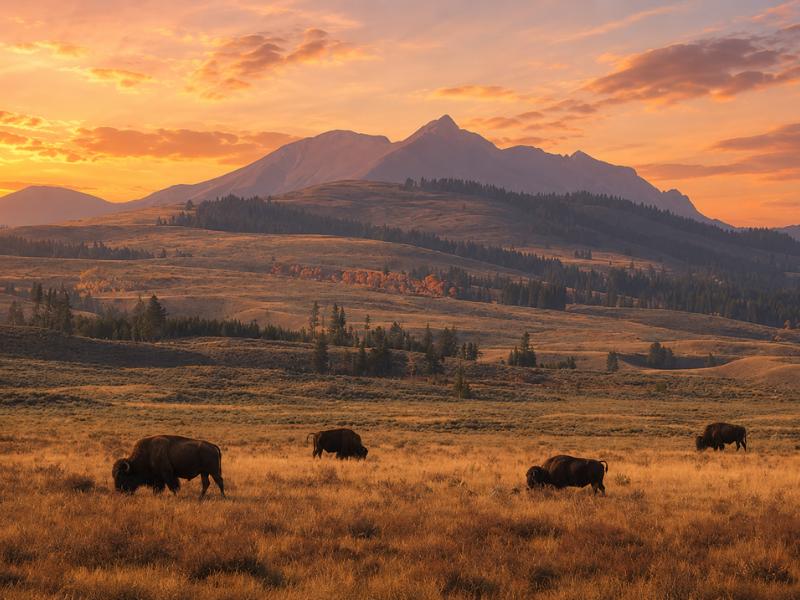
How many wolf packs live in Yellowstone, and where are they?
Yellowstone's wolf population fluctuates around 100 individuals organized into roughly 10 packs. The most frequently observed packs use territories in and around Lamar Valley, the park's northeastern corner, though packs also hold territories in Hayden Valley, Blacktail Plateau, and the interior backcountry.
Pack names change over the years as packs split, merge, or are displaced. As of recent years, the most consistently visible packs for road-based viewing have included the Junction Butte pack (Lamar Valley and Slough Creek area), the Rescue Creek pack (Blacktail Plateau and Mammoth area), and packs using the Hayden Valley corridor. Names shift, but the territories stay relatively stable because the valleys themselves provide the prey base that sustains the packs.
| Pack territory | Primary viewing areas | Road access | Best time of day |
|---|---|---|---|
| Lamar Valley (northeast) | Slough Creek, Footbridge pullout, Round Prairie, Pebble Creek | Tower Junction to Northeast Entrance road | First light (before sunrise to ~9 a.m.) |
| Blacktail Plateau (north-central) | Blacktail Ponds, between Mammoth and Tower Junction | Mammoth to Tower road | Dawn and dusk |
| Hayden Valley (central) | Grizzly Overlook, Hayden Valley pullouts south of Canyon Village | Canyon to Fishing Bridge road | Dawn; less reliable than Lamar for wolves |
| Interior / backcountry | Not accessible by road | Backcountry permit required | Variable |
The reason Lamar Valley dominates wolf watching is simple geography. The valley is roughly 30 miles long, wide and open, with sightlines that stretch for miles. When a pack moves through the valley floor or along a ridgeline, a trained observer with a spotting scope can pick them up from a roadside pullout a mile or more away. In forested areas of the park, a wolf could be 50 yards from the road and never be seen.
The park does not publish real-time wolf locations, but the wolf-watching community in Lamar Valley operates as an informal intelligence network. Dedicated watchers who park at pullouts before dawn share sightings with other observers, and guides from various companies communicate by radio. Joining a guided tour plugs you into that network immediately, which is the single biggest advantage over driving yourself.
When is the best time of year to see wolves in Yellowstone?
The two strongest windows are late spring (late May through early July, when pups emerge from dens and pack activity increases around den sites) and autumn through early winter (October through December, when wolves are more active, hunting larger prey, and visible against open terrain with less vegetation cover).
| Month | Wolf activity level | Viewing conditions | Other wildlife overlap |
|---|---|---|---|
| January to March | High (winter hunting, pack cohesion strong) | Wolves visible against snow; roads limited to North Entrance corridor only | Bison herds at thermal areas, coyotes, ravens |
| April to May | Moderate (denning season, adults near dens) | Some roads still closed; wolves may be less visible from road-accessible areas | Bears emerging from hibernation, elk calving |
| June to July | High (pups at rendezvous sites, pack visible together) | All roads open; longest daylight hours; warm mornings | Bison calves, bears with cubs, nesting raptors |
| August to September | Moderate (pups mobile, pack dispersing over larger range) | Good viewing; autumn light begins | Elk rut begins September, bears feeding intensively |
| October to November | High (pack hunting elk herds, visible on open terrain) | Excellent: minimal vegetation, dramatic light, low crowds | Elk rut, pre-hibernation bear activity |
| December | High (pack cohesion, hunting in open snow) | Snow makes wolves visible at extreme distances; short daylight hours | Bison near thermals, winter raptors |
Winter wolf watching is a category of its own. The Lamar Valley road between Mammoth and Cooke City stays open year-round (it's the only interior road that does), and January through March is when the most dedicated wolf watchers visit. Packs are easier to spot against snow, prey drives are more dramatic, and the competition for pullout space drops to a fraction of summer levels. The tradeoff is brutal cold: mornings regularly hit minus 10 to minus 20 Fahrenheit, and standing at a scope for two hours in those conditions requires serious cold-weather gear.
For summer visitors, the sweet spot is June. Pups are still at or near den sites (they move to "rendezvous sites" by July), pack activity around the dens creates predictable viewing windows, and the all-day daylight means both dawn and dusk sessions are available without sacrificing sleep entirely.
What does a wolf watching session actually look like?
A typical guided wolf watching session begins with a pre-dawn drive to Lamar Valley (departing lodging at 4:30 to 5:00 a.m. in summer), parking at a known pullout by first light, setting up a spotting scope, and scanning the valley floor, ridgelines, and known pack territories for movement. Most sessions last two to four hours, with long stretches of scanning punctuated by bursts of activity when wolves are located.
Patience is the defining characteristic. Wolf watching is not a drive-by experience. You don't cruise through the valley, snap a photo, and move on. You park, set up optics, and wait. A good guide fills that wait with context: pointing out elk herds and explaining why they're grouped the way they are, identifying raven activity that might signal a carcass (and therefore wolves nearby), and explaining the pack dynamics of the territory you're watching.
When wolves are spotted, the guide adjusts the scope and calls out the sighting: "Two adults and three pups at the tree line, nine o'clock from the big rock." Each viewer takes a turn at the scope. At 20-60x magnification, you can see individual markings, collar colors (many wolves carry GPS research collars), and behavioral details like a pup wrestling with a sibling or an adult scanning for prey.
On days when wolves aren't visible, a good session still produces other sightings. Lamar Valley is home to bison, pronghorn, coyotes, red foxes, bald eagles, and grizzly bears. No morning in Lamar Valley is ever truly empty. But the wolf-watching community measures a session by wolf contact, and multi-day tours dramatically increase the probability compared to a single morning attempt.
Should you book a guided wolf tour or try to spot wolves on your own?
For first-time wolf watchers, a guided tour is the clear choice. The difference is not about convenience. It's about access to the informal intelligence network that tracks pack locations in real time, plus the optics and expertise to identify wolves at distances where a self-driver would see nothing but grassland.
Self-drive wolf watching is genuinely possible. The road through Lamar Valley is public, the pullouts are free, and wolves are visible from the road on good days. But "good days" require knowing which pullout to use, when to arrive, and what to look for. A first-timer who drives to Lamar Valley at 8 a.m., parks at a random pullout, and scans with pocket binoculars for 30 minutes before giving up has done the equivalent of standing on a beach and trying to spot a specific ship on the horizon without knowing which direction to look.
| Factor | Guided wolf tour | Self-drive wolf watching |
|---|---|---|
| Probability of wolf sighting | High (guide tracks packs daily, uses radio network) | Low to moderate (depends on luck, timing, experience) |
| Optics quality | Professional spotting scopes (20-60x), binoculars provided on some tours | Whatever you bring |
| Pack identification | Guide identifies pack, individuals by collar, and behavior context | You see "a wolf" without knowing which pack or why it's doing what it's doing |
| Schedule discipline | Guide gets you there before first light | Requires self-discipline to set a 4 a.m. alarm on vacation |
| Cost | Part of a multi-day tour package | Free (road access is included with park entrance fee) |
The most common self-drive mistake, besides arriving too late, is leaving too early. A pack that wasn't visible at 6 a.m. might emerge onto a ridgeline at 7:30. A guide stays because they know the pack's patterns. A self-driver, getting cold and impatient, often drives off to find something else, and misses the sighting by 20 minutes.
Which tours include dedicated wolf watching?
The 5-day hotel-based tour from Bindlestiff Tours is the strongest wolf-watching option because it includes a wolf-tracking expert on the guide team, not just a general naturalist. At around $2,995 per person with a perfect 5.0 rating across 170+ bookings, it's built for visitors whose primary draw is wolves.
The wolf-tracking expert difference matters more than any other single feature. General naturalist guides know where wolves have been seen recently. A wolf-tracking expert has spent years monitoring specific packs, knows their movement patterns across seasons, and often has personal relationships with the research community that provides additional location data. This specialization is why the 5-day hotel tour commands a premium over comparably-lengthed camping options.
| Tour | Days | Operator | Price (from) | Rating | Wolf-watching specifics |
|---|---|---|---|---|---|
| 5-Day Hotel In-Depth | 5 | Bindlestiff Tours | ~$2,995 | 5.0 | Wolf-tracking expert on team, dedicated Lamar Valley sessions, hotel lodging, 13-person max |
| Wildlife Adventure 4 Days | 4 | BrushBuck Wildlife Tours | ~$2,198 | 4.8 | Naturalist guide, binoculars + spotting scope, Lamar Valley in itinerary, ages 6+ |
| Discovery Classic Tour | 7 | Insight Vacations | ~$6,012 | 5.0 | Lamar Valley drive included, but focus is broader (cultural, scenic, luxury coach) |
The Discovery Classic Tour includes a Lamar Valley wildlife drive, but wolves are one element of a much broader 7-day luxury itinerary, not the focus. Visitors whose primary goal is wolves should choose one of the first two options. Visitors who want wolves as part of a wider, more comfortable Yellowstone experience might find the Classic Tour's combination of wildlife, cultural experiences (including an Apsaalooke Nation heritage visit), and luxury coach travel appealing at a different level.
What equipment do you need for wolf watching?
A spotting scope is the gold-standard tool for wolf watching. If you're on a guided tour, the guide provides one. If you're self-driving, renting a 20-60x spotting scope with a tripod from a gateway-town outfitter is the single most impactful equipment decision you can make.
| Equipment | Purpose | Essential or optional? |
|---|---|---|
| Spotting scope (20-60x) with tripod | Identifying wolves at 0.5 to 2 miles, seeing collar colors and individual markings | Essential for self-drivers; provided on guided tours |
| Binoculars (10x42 minimum) | Scanning wide areas quickly to locate movement before switching to the scope | Essential |
| Camera with 400mm+ telephoto | Documenting sightings; wolves at typical viewing distances require serious reach | Optional but rewarding if you have the glass |
| Camp chair or stool | Comfort during 2-4 hour pullout sessions | Highly recommended for self-drivers |
| Thermos, hot drinks, snacks | Pre-dawn sessions in 30-40 degree weather | Essential for comfort |
| Warm layers, gloves, hat | Lamar Valley is exposed, windy, and cold at dawn even in summer | Essential |
| Radio scanner (optional) | Monitoring the informal guide radio channel for sighting reports | Optional; a guide provides this natively |
One piece of gear deserves special mention: a two-way radio or scanner tuned to the local spotters' frequency. The Lamar Valley wolf-watching community uses VHF radio to share sightings. Some dedicated self-drivers carry a scanner to listen in, which provides a fraction of the intelligence a guided tour offers. This is a gray area in terms of etiquette, and the community is protective of pack locations, so use discretion if you go this route.
How have wolves changed Yellowstone's ecosystem?
The 1995 wolf reintroduction triggered what ecologists call a trophic cascade, a chain of effects that rippled from wolves through elk, vegetation, streambank erosion, and eventually the behavior of rivers themselves. Understanding this cascade adds a layer of meaning to every wolf sighting that purely aesthetic viewing doesn't provide.
Before wolves were reintroduced, Yellowstone still had large predators, including bears and cougars. Wolf recovery added another influence on elk behavior and abundance. Changes in vegetation, waterways and beavers involve several interacting ecological factors; they cannot all be attributed to wolves alone.
After reintroduction, wolves changed elk behavior as much as elk numbers. Elk became warier, spending less time grazing in exposed valley bottoms and near riverbanks where they were vulnerable to predation. Willows and aspens began to recover in some areas, particularly along Lamar Valley stream corridors. Beavers returned to some of these restored riparian areas, building dams that created ponds, which in turn provided habitat for fish, amphibians, songbirds, and other species.
The cascade didn't play out uniformly across the park, and ecologists continue to debate how much of the vegetation recovery is attributable to wolves versus other factors like climate and precipitation changes. But the broad pattern is real and visible. A guide who explains the trophic cascade while you're watching wolves in Lamar Valley turns what could be a simple animal sighting into an ecology lesson that reshapes how you see every other landscape in the park.
This ecological story is part of why the 5-day hotel-based tour includes a wolf-tracking expert rather than just a general naturalist. The specialist doesn't just find wolves. They explain what those wolves mean for the valley you're standing in, the river you crossed to get there, and the aspen grove on the hillside above. That interpretive layer is what separates a wolf sighting from a wolf experience.
What's the difference between wolf watching in summer versus winter?
Summer wolf watching offers easier logistics (all roads open, warmer mornings, longer daylight) but wolves are harder to spot because vegetation is dense and they range over larger areas. Winter wolf watching offers dramatically better visibility (wolves against snow, concentrated prey herds, shorter travel distances for packs) but punishing cold and limited road access.
| Factor | Summer (June to September) | Winter (December to March) |
|---|---|---|
| Visibility | Moderate: green vegetation, wide ranges | Excellent: white snow, dark wolves, concentrated herds |
| Road access | All roads open | Only Mammoth to Cooke City (through Lamar Valley) |
| Temperature at dawn | 30-50 degrees F | Minus 10 to 15 degrees F |
| Daylight hours | 15+ hours | 8-9 hours |
| Crowd level at pullouts | Moderate to high | Low |
| Pack behavior | Denning, pup-rearing, dispersed hunting | Pack hunting of elk, dramatic chases, carcass feeding |
| Best for | First-timers, families, combined geyser + wildlife trips | Dedicated wolf watchers, photographers, experienced cold-weather visitors |
Winter wolf watching attracts a dedicated community of repeat visitors who return year after year, sometimes for weeks at a time. The small town of Silver Gate, just outside the Northeast Entrance, serves as an informal base camp for this community. Accommodations are limited and basic compared to summer options, but the experience is qualitatively different: watching a wolf pack chase an elk herd across a snow-covered valley at first light is among the most dramatic wildlife spectacles anywhere in North America.
For visitors interested in winter snowmobile tours, the interior of the park offers its own wolf encounters, though the Lamar Valley road-based watching remains the primary winter wolf-watching venue.
Where should you stay for wolf watching in Yellowstone?
The closest lodging to Lamar Valley is in Cooke City or Silver Gate, Montana, just outside the Northeast Entrance. Staying here puts you 15 to 30 minutes from prime wolf watching pullouts at dawn, compared to 1.5 to 2 hours from West Yellowstone or Jackson Hole. That time difference matters enormously when the alarm goes off at 4:30 a.m.
Inside the park, Roosevelt Lodge (seasonal, cabins only) and Mammoth Hot Springs Hotel are the closest in-park lodging options to Lamar Valley. Roosevelt is roughly 20 minutes from the valley by car. Mammoth is about 40 minutes. Both are popular with wildlife-focused visitors and book out months in advance for summer.
| Lodging location | Drive to Lamar Valley | Type | Season | Notes |
|---|---|---|---|---|
| Cooke City / Silver Gate, MT | 15-30 min | Small motels, cabins | Year-round (limited winter) | Closest to Lamar; limited dining options; tight-knit wolf-watching community |
| Roosevelt Lodge (in-park) | ~20 min | Rustic cabins | Seasonal (June to early September) | No TV, no phones, campfire atmosphere; books out 6+ months ahead |
| Mammoth Hot Springs Hotel (in-park) | ~40 min | Hotel rooms and cabins | Year-round | Most amenities of any in-park option near the northern range |
| Gardiner, MT | ~60 min | Hotels, motels, vacation rentals | Year-round | More lodging variety; adds morning drive time |
| West Yellowstone, MT | ~2 hours | Hotels, motels, cabins | Year-round | Most lodging options overall, but too far for practical pre-dawn wolf watching |
On guided tours, the lodging question is handled for you. The 5-day hotel tour stages its wolf-watching days from lodging positioned to minimize morning drive time. The camping tours camp inside or adjacent to the park, which often puts you closer to Lamar Valley than any hotel option. This is one of the less-discussed advantages of guided tours: the operator has already solved the lodging-proximity optimization that self-planners spend hours researching.
Can you hear wolves howl in Yellowstone?
Yes, and it's the single most emotionally powerful moment a wolf watching trip can produce. Wolf howling is most commonly heard at dawn and dusk, when packs communicate across territories. Lamar Valley's acoustics carry howls for miles, and on a still morning, a chorus from a pack on a distant ridgeline is audible from roadside pullouts without any amplification.
Howling is not rare, but it's not predictable. Packs howl to communicate with distant members, to assert territorial boundaries, and sometimes in response to stimuli like coyote yipping or other packs howling nearby. A multi-day tour with several dawn sessions gives you the best chance of hearing it, since each morning is an independent opportunity.
Guides with years of Lamar Valley experience can sometimes predict when howling is more likely, based on pack behavior patterns. If a pack has been split (some members at a carcass, others near the den), dawn howling to regroup is common. If two packs' territories overlap near a kill site, territorial howling can erupt at any hour.
For those planning a broader Yellowstone trip and want to see how wolf watching fits into a multi-day schedule, our Yellowstone itinerary planner maps out 3, 4 and 5-day options. And for general wildlife tour comparisons covering all species beyond wolves, that guide covers the full range of what's available.
To compare all wolf-friendly tour packages side by side, browse Yellowstone tour packages on our homepage.