Yellowstone vs Glacier National Park: How to Choose
Yellowstone and Glacier sit in the same corner of the American West, roughly 370 miles apart, and visitors with limited time often ask which one to prioritize. They are genuinely different parks with different strengths. Here is a direct comparison.
Choose the trip that fits your gateway, available time and actual party needs.
Booking choice: Old Faithful, Grand Prismatic and Canyon with a guide, lunch and binoculars. Up to 13 hours with travel; moderate walking. Select Jackson/Teton pickup points. Confirm park fees for your residency.
Explore Jackson Lower Loop day tourWe may earn a commission when you book through these links.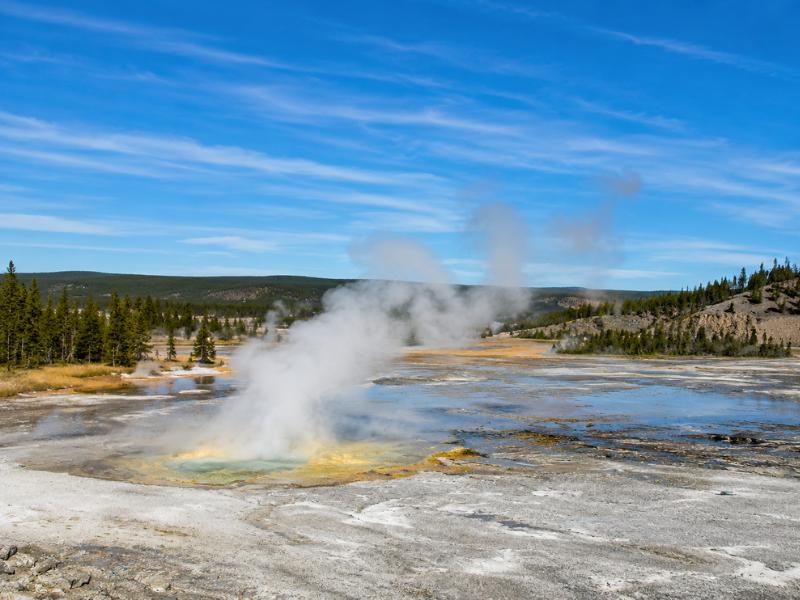
What makes each park distinct?
Yellowstone is a geothermal park. Glacier is an alpine park. That single distinction drives almost every difference in what you see, what you do and when you can visit.
Yellowstone sits on top of a volcanic hotspot that powers roughly 10,000 thermal features: geysers, hot springs, mudpots and fumaroles. It covers 2.2 million acres across Wyoming, Montana and Idaho, and its landscape ranges from river valleys and open grasslands to deep canyons and high-altitude lakes. The wildlife, wolves, grizzly bears, bison, elk, is the other headline: Yellowstone is one of the last places in the lower 48 states where large predators roam in visible numbers.
Glacier National Park covers 1,012 square miles in northwestern Montana, built around alpine peaks, glacially carved valleys, and the iconic Going-to-the-Sun Road, a 50-mile engineering feat that climbs over the Continental Divide at Logan Pass (6,646 feet). Glacier's appeal is vertical: jagged peaks, turquoise lakes fed by snowmelt, and alpine meadows filled with wildflowers in July and August. It still has grizzly bears and mountain goats, but the headline is the landscape itself rather than any single species.
Side-by-side comparison
| Factor | Yellowstone | Glacier |
|---|---|---|
| Size | 2.2 million acres (3,471 sq miles) | 1,012 sq miles |
| Signature feature | Geysers, hot springs (Old Faithful, Grand Prismatic) | Alpine peaks, glacially carved valleys, Going-to-the-Sun Road |
| Wildlife highlights | Wolves, grizzly bears, bison herds, elk | Grizzly bears, mountain goats, bighorn sheep |
| Iconic drive | Grand Loop Road (142 miles, figure-eight) | Going-to-the-Sun Road (50 miles, crosses Continental Divide) |
| Road season | Most roads open late April through early November | Going-to-the-Sun Road typically open late June through mid-October |
| Winter access | Snowcoach and snowmobile tours, Mammoth-Cooke City road open | Very limited: most roads closed, park accessible by ski or snowshoe only |
| Nearest major airport | Bozeman (BZN), 90 miles north; Jackson (JAC), 57 miles south | Glacier Park International (FCA), Kalispell, 30 miles west |
| Annual visitors (approx.) | 4.5 million+ | 3 million+ |
| Vehicle reservation needed | No (as of current seasons) | Yes, for Going-to-the-Sun Road corridor in peak season |
Which park is better for wildlife?
Yellowstone, by a wide margin. The Lamar Valley alone, often called the "Serengeti of North America," holds wolf packs, grizzly bears, bison herds numbering in the thousands, coyotes, pronghorn and elk. The Hayden Valley adds another major wildlife corridor between Canyon Village and Yellowstone Lake. Dedicated wildlife tours run the Lamar Valley at dawn with spotting scopes specifically to find wolves and bears.
Glacier has grizzly bears, mountain goats, bighorn sheep, and marmots, but its steep terrain and dense forest make sightings less predictable and less frequent than Yellowstone's open valleys. Mountain goats at Logan Pass are the most reliable Glacier wildlife sighting, and they are genuinely impressive, but they do not compare to watching a wolf pack on a bison kill in the Lamar Valley.
If wildlife watching is your primary reason for visiting a national park, Yellowstone is the clear choice. For more on timing your visit around specific animals, see best time to see wolves in Yellowstone and best time to see bears in Yellowstone.
Which park has better scenery?
This is the one category where personal taste genuinely decides the answer. Yellowstone's scenery is horizontal and strange: steaming basins, rainbow-colored hot springs, a canyon with a waterfall that rivals its Arizona namesake in drama if not in depth. Glacier's scenery is vertical and classical: alpine peaks, cirque lakes, hanging valleys and the kind of mountain vistas that make people pull over and forget they were driving somewhere.
Going-to-the-Sun Road is one of the most spectacular drives in North America by any measure. It crosses the Continental Divide through a narrow, cliff-hugging road carved into sheer rock walls, with views that change from dense cedar forest to alpine tundra within 50 miles. No road in Yellowstone matches it for pure scenic drama per mile driven.
But Yellowstone has Grand Prismatic Spring, a hot spring so large and so brightly colored that it looks artificial from the overlook. It has the Grand Canyon of the Yellowstone, where the Yellowstone River drops 308 feet over the Lower Falls into a yellow-walled canyon. And it has the eerie, other-worldly landscape of the thermal basins, where the ground hisses and steams and smells of sulfur. The scenery is completely different in character, not lesser.
When can you visit each park?
Yellowstone has a longer accessible season than Glacier. Most Yellowstone roads open in late April and close in early November, and the park offers a full winter tour season with snowcoach and snowmobile tours from mid-December through early March.
Glacier's Going-to-the-Sun Road typically does not open until late June or even early July, depending on snowpack, and closes again by mid-October. The window for driving the park's signature road is roughly three and a half months. Outside that window, Glacier is accessible on foot, by ski, or by snowshoe, but the experience most visitors come for, driving Going-to-the-Sun Road and hiking the trails it accesses, requires a summer or early fall visit.
This difference matters for trip planning. A May visit gives you full access to Yellowstone (spring wildlife, melting snow, relatively low crowds) but no access to Glacier's high road. An August visit works for both parks but puts you in peak-crowd season at each. The best time to visit Yellowstone guide covers month-by-month conditions in detail.
Can you visit both on one trip?
Yes, but the 370-mile drive between the two parks takes roughly five to six hours on two-lane highways through rural Montana. It is a beautiful drive through the Montana high plains, but it is a full travel day, not a quick hop.
A realistic both-parks trip needs at least seven to nine days: three to four days for Yellowstone, one travel day between parks, and three to four days for Glacier. Fewer than that and you spend too much time in the car relative to time in the parks. Some visitors fly into Bozeman (for Yellowstone) and out of Kalispell (for Glacier), or vice versa, to avoid backtracking.
Multi-day Yellowstone packages can anchor the Yellowstone part of a two-park trip. Plan the transfer and Glacier visit separately. A self-drive audio bundle can add narration in both parks, but does not provide transport, lodging or entry.
Which park should you choose?
If you want geysers, hot springs and world-class wildlife watching, go to Yellowstone. If you want alpine peaks, glacially carved valleys and one of America's greatest scenic drives, go to Glacier. If you want both and have the time, do both, starting with whichever park's season aligns with your travel dates.
For first-time visitors to the American West who can only pick one park on this trip, Yellowstone is usually the recommendation. Its combination of geothermal features and megafauna wildlife is globally unique, and its longer season and more developed tour infrastructure make it easier to plan around. Glacier is the more rugged, more remote, more weather-dependent choice, and its short road season means you have less scheduling flexibility.
Neither choice is wrong. Both parks rank among the best in the National Park system, and visitors who see one almost always come back for the other. To start planning the Yellowstone side, browse Yellowstone tour packages and compare formats, dates and price points across the available options.