Yellowstone vs Grand Canyon: Which National Park to Visit?
Two of the most visited national parks in the US, two completely different landscapes, and a question that comes up every time someone plans a western road trip. Here is what actually separates them and how to choose.
Choose the trip that fits your gateway, available time and actual party needs.
Booking choice: Old Faithful, Grand Prismatic and Canyon with a guide, lunch and binoculars. Up to 13 hours with travel; moderate walking. Select Jackson/Teton pickup points. Confirm park fees for your residency.
Explore Jackson Lower Loop day tourWe may earn a commission when you book through these links.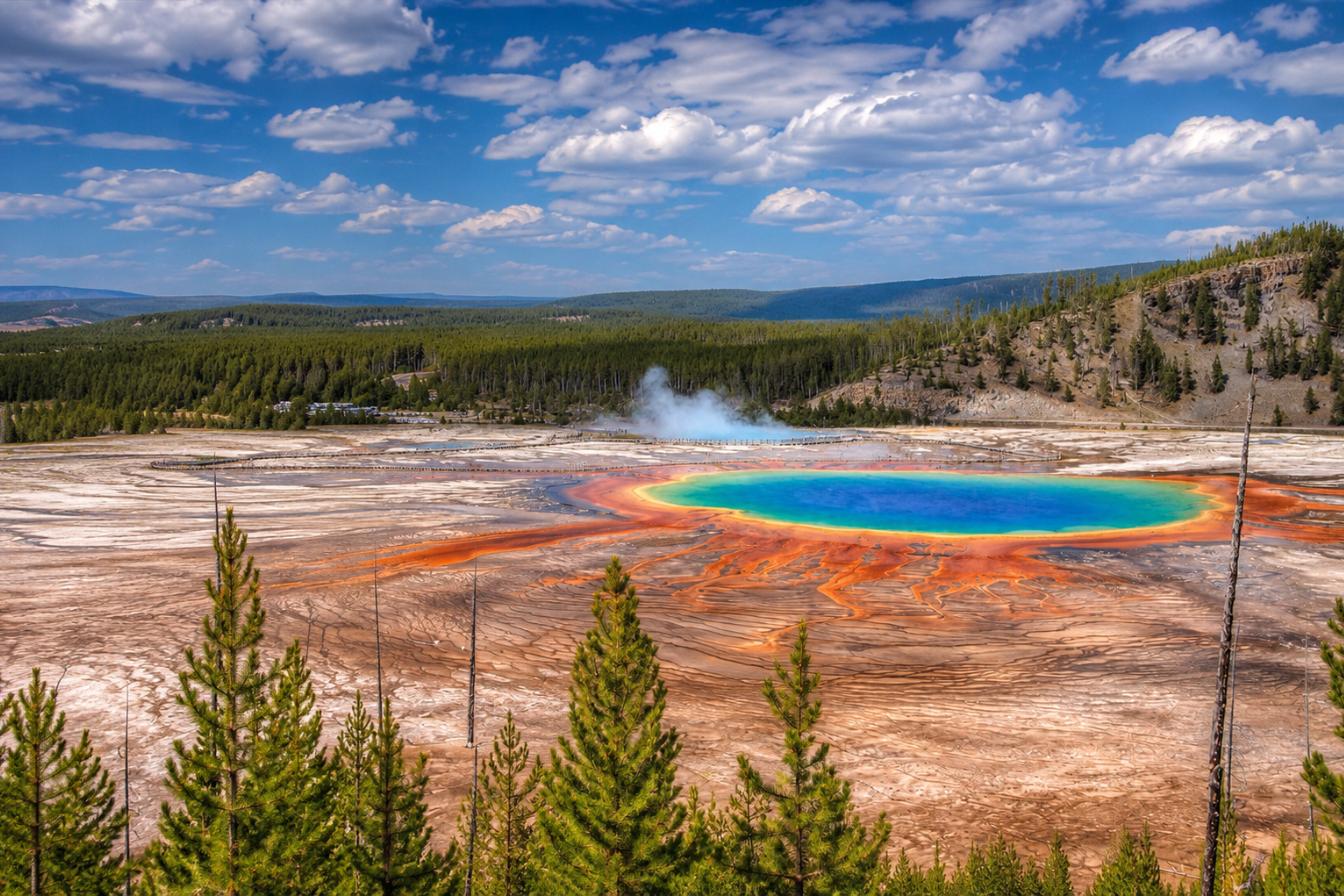
What kind of landscape are you actually comparing?
Yellowstone is a volcanic plateau sitting on top of a supervolcano, defined by geysers, hot springs, boiling mud pots and wildlife corridors. The Grand Canyon is a 277-mile-long gorge cut by the Colorado River over roughly six million years, defined by layered rock walls that drop over a mile from rim to river. They share the word "national park" and not much else.
Yellowstone covers 2.2 million acres across Wyoming, Montana and Idaho. The Old Faithful and Grand Prismatic tour route passes through just one section of the park's thermal basin system, which holds about half the world's active geysers. The Grand Canyon covers 1.2 million acres in northern Arizona, and most visitors see it from the South Rim, a developed corridor with overlooks, shuttle buses and paved trails along the edge.
The point is not that one is better. It is that they deliver entirely different experiences. Yellowstone is alive in a biological sense: bison herds crossing the road, wolves visible at dawn in Lamar Valley, elk bugling in September. The Grand Canyon is alive in a geological sense: two billion years of the Earth's crust exposed in horizontal bands you can read like a textbook if you know what you are looking at.
How does wildlife compare between the two parks?
Yellowstone has the most concentrated large-mammal population in the lower 48 states: grizzly bears, wolves, bison, elk, moose, pronghorn and mountain lions all live inside park boundaries. The Grand Canyon has California condors, mule deer, bighorn sheep and elk on the North Rim, but large-predator sightings are rare.
If wildlife is the primary draw, Yellowstone wins outright. The Yellowstone wildlife tours guide covers the specific valleys and seasons that produce the best sightings. The BrushBuck 4-day wildlife adventure provides binoculars, spotting scopes and a naturalist guide whose job is to find animals in Lamar Valley, Hayden Valley and Oxbow Bend. Nothing at the Grand Canyon matches that density or that level of guided wildlife access.
The Grand Canyon's wildlife appeal is narrower but genuine. The California condor reintroduction program has brought one of the world's rarest birds back to the canyon's thermals. Bighorn sheep pick their way along the inner canyon walls. But these are sightings you hope for, not experiences a guide can reliably deliver on a schedule.
Which park fits a shorter trip?
The Grand Canyon works better for a one-day visit: drive to the South Rim, walk the Rim Trail, hit a few overlooks, eat at a lodge, drive home. Yellowstone needs a minimum of two full days to cover even the major thermal features and one wildlife corridor, and three to four days is more realistic.
This is the single biggest practical difference. The Grand Canyon's South Rim is about 80 miles from Flagstaff and 275 miles from Las Vegas, both drivable in a morning. You can see the canyon, feel the scale, take photos and leave in a single day. Yellowstone's Grand Loop Road alone is 142 miles. Driving it without stops takes over four hours. Add Old Faithful wait times, boardwalk loops, wildlife jams and the distance from gateway towns, and one day gives you a rushed greatest-hits drive with no time to actually stop.
The guide on how many days you need in Yellowstone breaks this down by itinerary length. A 4-day camping tour from Salt Lake City or a 5-day hotel-based tour from Bozeman both represent the realistic minimum for covering the park's highlights without rushing past them.
Side-by-side comparison
The table below puts the practical differences in one place.
| Factor | Yellowstone | Grand Canyon |
|---|---|---|
| Primary landscape | Volcanic plateau: geysers, hot springs, canyons, rivers | River-carved gorge: layered rock walls, rim overlooks |
| Wildlife density | High (bison, grizzlies, wolves, elk, moose) | Moderate (condors, bighorn sheep, mule deer) |
| Minimum useful visit | 2-3 days | 1 day (South Rim drive) |
| Ideal visit | 4-7 days | 2-3 days (rim + inner canyon hike or raft) |
| Nearest major airport | Bozeman (BZN) or Jackson Hole (JAC) | Flagstaff (FLG) or Las Vegas (LAS) |
| Best season | June-September (wildlife + geysers), December-March (winter tours) | March-May, September-November (moderate temps) |
| Guided tour format | Multi-day packages (4-7 days), hotel or camping | Day trips from Vegas or Flagstaff, multi-day raft trips |
| ADA / boardwalk access | Extensive boardwalks at geyser basins, many accessible overlooks | Paved Rim Trail on South Rim, shuttle-served overlooks |
How do tour formats and costs compare?
Budget note: Price figures in the editorial comparisons are planning examples, not current quotes. Compare the same dates, travelers and inclusions. Park fees depend on pass coverage and residency; confirm any nonresident surcharge before booking.
Yellowstone tours run multi-day by nature. A 4-day camping tour starts around $1,050, a 5-day hotel-based tour around $2,995, and a 7-day luxury coach tour around $6,012. Grand Canyon tours are mostly single-day or two-day trips from Las Vegas or Flagstaff, running $100 to $300 for a bus/van day trip, with multi-day raft trips costing $1,500 to $4,000+.
The cost difference reflects time, not quality. Yellowstone tours include multiple nights of accommodation (camping or hotel), meals, park fees and a guide for several days. Grand Canyon day trips include transport and a few hours at the rim. Comparing a $200 Grand Canyon day trip to a $2,995 five-day Yellowstone hotel tour is comparing a lunch to a week of groceries.
The guided tours of Yellowstone page lays out the full range of multi-day options. A 7-day tour that also covers Devils Tower and Mount Rushmore across four states runs $3,545 and turns the trip into a broader western-US circuit rather than a single-park visit.
Can you visit both on one trip?
Yes, but expect 10 to 14 days minimum, and roughly 900 miles of driving between the two parks (about 12 hours one way through Utah). Most people who do both pick one for a dedicated multi-day visit and add the other as a shorter stop on the drive.
A practical combined approach: fly into Salt Lake City, drive north to Yellowstone for a 4-day tour, then drive south through Utah to the Grand Canyon's North Rim (closer from that direction), spend a day there, and fly out of Las Vegas. That covers roughly 750 miles of actual driving split across travel days, with a Yellowstone-heavy itinerary and the Grand Canyon as a bookend.
If your window is under a week, pick one. Yellowstone for wildlife, geysers and a full immersion in wild landscape. The Grand Canyon for accessible geological spectacle, rim-top views and a shorter time commitment. Both are real, and neither is the wrong choice. You can always browse Yellowstone tour packages to see what multi-day options fit the dates you actually have.