Yellowstone Geyser Tour: Old Faithful, Grand Prismatic, and the Thermal Basins
Yellowstone contains more than 10,000 thermal features, roughly half the world's total, packed into a caldera the size of Rhode Island. The five major thermal areas that multi-day tours visit, Old Faithful and the Upper Geyser Basin, Grand Prismatic Spring, Norris Geyser Basin, Mammoth Hot Springs, and West Thumb Geyser Basin, are each different enough that visiting one does not prepare you for the next. Here is what to expect at each, which tours take you to which basins, and how to time your visit for the best experience.
Choose the trip that fits your gateway, available time and actual party needs.
Booking choice: Old Faithful, Grand Prismatic and Canyon with a guide, lunch and binoculars. Up to 13 hours with travel; moderate walking. Select Jackson/Teton pickup points. Confirm park fees for your residency.
Explore Jackson Lower Loop day tourWe may earn a commission when you book through these links.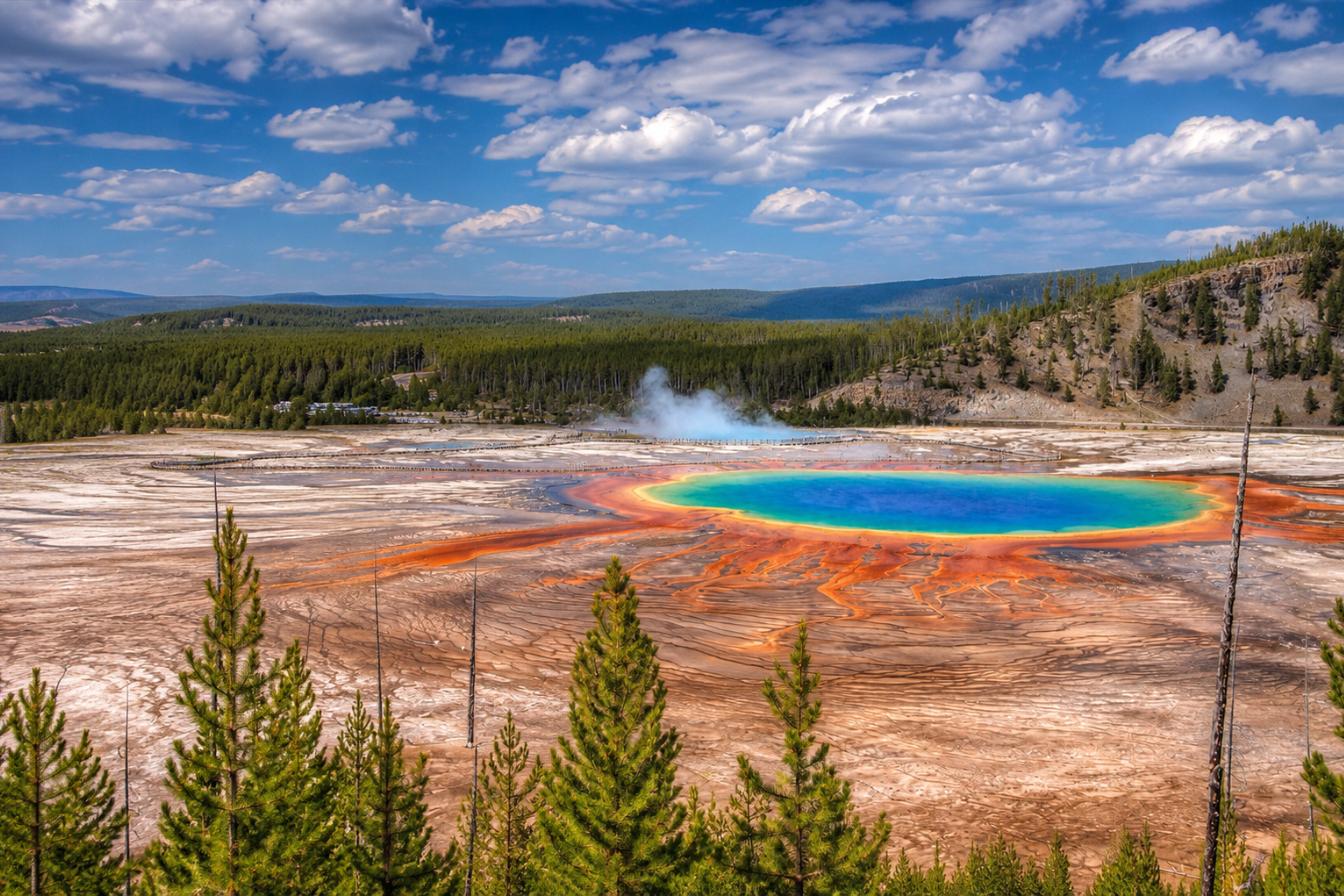
Why does Yellowstone have so many geysers in one place?
Yellowstone sits on top of an active volcanic hotspot where a magma chamber lies roughly 3-8 miles below the surface, heating groundwater to temperatures above 400 degrees F and forcing it upward through fractured rock to produce the world's densest concentration of geysers, hot springs, mud pots, and fumaroles. The park contains about 500 geysers, which is more than all other geyser fields on Earth combined. That number is not inflated for marketing; it is the U.S. Geological Survey's working count.
The caldera itself formed during a massive eruption roughly 640,000 years ago, and the resulting collapsed volcanic crater is roughly 34 by 45 miles across. The thermal features visible today are surface expressions of that underlying heat engine. Different thermal features form depending on the specific plumbing: a geyser has a constricted vent that traps steam until pressure forces an eruption; a hot spring has an open vent that releases heat continuously without erupting; a mud pot forms where acidic water dissolves rock into clay; and a fumarole is a steam vent with little or no liquid water. All four types are visible along Yellowstone's boardwalks.
Understanding the geology is not just academic. It explains why the boardwalk rules exist: the ground in thermal areas is often a thin siliceous crust over boiling or superheated water. Stepping off the boardwalk can mean stepping through that crust. The park's thermal safety record includes fatalities from people who left the designated path. Every guide on every multi-day tour enforces the boardwalk rule, and understanding why makes it easier to comply without feeling like the rule is arbitrary. The guided tours overview covers how each operator handles thermal safety as part of the broader tour experience.
What happens at Old Faithful, and how do you time the eruption?
Old Faithful erupts roughly every 90 minutes, with the interval ranging from about 60 to 110 minutes, shooting 3,700 to 8,400 gallons of boiling water 100 to 180 feet into the air for a duration of 2 to 5 minutes. The eruption is predicted by the National Park Service based on the duration of the previous eruption: a short eruption (under 2.5 minutes) predicts a shorter wait until the next one, and a long eruption (over 4 minutes) predicts a longer wait. Predictions are posted at the Old Faithful Visitor Education Center and are accurate to within about 10 minutes.
Every multi-day tour on this site includes an Old Faithful stop, and guides time their arrival to coincide with a predicted eruption. The practical experience is straightforward: you arrive at the viewing benches, which are arranged in a semicircle about 100 yards from the vent, wait for the eruption (typically 10-30 minutes if you arrived on schedule), watch the water column rise and the steam billow, and then walk the Upper Geyser Basin boardwalk while waiting for the area's other geysers.
| Old Faithful fact | Detail |
|---|---|
| Average interval between eruptions | ~90 minutes (range: 60-110 minutes) |
| Water height | 100-180 feet |
| Water volume per eruption | 3,700-8,400 gallons |
| Water temperature at vent | ~204 F (boiling at this elevation) |
| Duration of eruption | 2-5 minutes |
| Prediction accuracy | Within ~10 minutes, posted at Visitor Center |
The Upper Geyser Basin surrounding Old Faithful contains roughly 150 other thermal features within a 1-square-mile area, making it the densest geyser concentration on Earth. A 3-mile boardwalk loop connects Old Faithful to several other notable geysers: Castle Geyser (erupts every 10-12 hours, sprays 75 feet), Grand Geyser (erupts every 6-8 hours, the tallest predictable geyser in the world at up to 200 feet), and Riverside Geyser (erupts every 5.5-6.5 hours along the Firehole River). The loop takes about 90 minutes to walk at a moderate pace, which conveniently fills the interval between Old Faithful eruptions.
The Old Faithful Inn, built in 1903-1904, is worth entering even if you are not staying there. The lobby features a 65-foot-high log-frame interior with a massive stone fireplace, and it is the largest log structure in the world. It sits within a few hundred yards of the geyser, and most tour groups stop inside after watching an eruption. The inn is a National Historic Landmark, and the craftsmanship of the exposed log framing is genuinely impressive regardless of your interest in architecture.
How is Grand Prismatic Spring different from a geyser?
Grand Prismatic Spring is not a geyser; it is the largest hot spring in the United States, measuring roughly 370 feet in diameter and 160 feet deep, with a constant output of about 560 gallons of 160 F water per minute. It does not erupt. Its fame comes from the vivid color rings produced by heat-loving bacteria (thermophiles) that live in the mineral-rich water at different temperature zones, creating concentric bands of blue, green, yellow, orange, and red radiating outward from the deep blue center.
The colors are real and not enhanced in the photographs that make the spring famous, but they are dramatically affected by viewing conditions. From the boardwalk at water level, you see the bacterial mats in vivid color but cannot see the full circular pattern. From the Grand Prismatic Overlook trail (a 1.2-mile round-trip path climbing a hillside south of the spring), you look down and see the full ring pattern. On cool mornings, thick steam obscures the colors entirely from any angle. On warm midday visits in summer, the steam thins and the colors are at their most vivid.
| Viewing option | What you see | Best conditions | Walk distance |
|---|---|---|---|
| Boardwalk (water level) | Close-up of bacterial mats, edge detail, steam | Any conditions, but steam limits visibility on cool days | ~0.5 mile from parking area |
| Overlook trail (elevated) | Full ring pattern from above, the "postcard" view | Warm midday (above 70 F air temp), calm wind | 0.6 mile out-and-back with elevation gain |
Grand Prismatic Spring sits in the Midway Geyser Basin, about 6 miles north of Old Faithful along the Grand Loop Road. The same basin contains Excelsior Geyser Crater, which was once the world's largest active geyser (erupting 300 feet, last major eruption in 1985) and now functions as a massive hot spring discharging 4,000 gallons per minute into the Firehole River. The runoff from Excelsior creates a dramatic steam cloud visible from the road and a river-temperature gradient that is interesting to observe even if you are not a geologist.
Tours that include both Old Faithful and Grand Prismatic typically visit them on the same day because the two features are only 6 miles apart by road. The G Adventures camping explorer includes both as part of its dedicated thermal day. The Bindlestiff 5-day hotel-based tour covers both as part of its southern loop. The BrushBuck wildlife tour includes Old Faithful but does not specifically list Grand Prismatic, though the proximity means a stop is possible depending on the guide's schedule that day. The photography tours guide covers optimal camera settings and timing for Grand Prismatic in detail.
What makes Norris Geyser Basin different from the Old Faithful area?
Norris Geyser Basin is the hottest, oldest, and most chemically dynamic thermal area in Yellowstone, with ground temperatures recorded above 459 F at just 1,087 feet below the surface, and its features change noticeably from year to year as the underground plumbing shifts. Where Old Faithful is predictable and photogenic, Norris is raw, acidic, and unsettling in a way that makes the volcanic reality of the park impossible to ignore.
Norris divides into two distinct areas connected by boardwalks: Porcelain Basin and Back Basin. Porcelain Basin is an open, pale-colored expanse of milky blue pools, hissing steam vents, and iron-stained runoff channels. The acidity of the water here (pH as low as 1.2, comparable to battery acid) dissolves and redeposits minerals constantly, which is why the landscape looks almost lunar. Back Basin is more forested and contains Steamboat Geyser, the world's tallest active geyser, which can erupt over 300 feet when it goes off. Steamboat's eruptions are irregular and unpredictable, with gaps ranging from four days to fifty years, so seeing an eruption is genuinely rare and largely a matter of luck.
| Norris feature | What you see | Significance |
|---|---|---|
| Porcelain Basin | Open expanse of milky blue pools, steam vents, mineral deposits | Most acidic thermal area in the park (pH as low as 1.2) |
| Steamboat Geyser | Steam vent (eruptions unpredictable) | World's tallest active geyser (300+ feet when it erupts) |
| Echinus Geyser | Acidic geyser pool | One of the few acidic geysers in the world |
| Crackling Lake | Large hot spring, deep blue | Named for the cracking sounds of the surrounding ground |
The Bindlestiff 5-day hotel-based tour and the Insight Vacations 7-day tour both include Norris as a dedicated stop because their northern entry from Bozeman passes directly through this area. Tours entering from the south (Jackson Hole departures) may not include Norris unless the itinerary specifically routes north along the Grand Loop. This is one of the genuine advantages of a Bozeman-departing tour for travellers who want to see the full range of Yellowstone's thermal diversity rather than just the Old Faithful corridor. The Bozeman departure guide covers the full northern routing.
What does Mammoth Hot Springs look like, and how is it different?
Mammoth Hot Springs is a series of terraced limestone formations built by hot water dissolving underground limestone (calcium carbonate) and redepositing it on the surface at a rate of about two tons per day, creating white and orange travertine terraces that look like a frozen cascade of mineral-laden water. It is visually unlike anything else in Yellowstone because the base rock is limestone rather than the rhyolite and obsidian that dominate the rest of the park's thermal areas.
The terraces change constantly. A terrace that was flowing and actively depositing mineral last year may be dry and crumbling this year, while a previously dry area suddenly activates with new hot water channels. This dynamism means that photographs of Mammoth from five or ten years ago may not match what you see today. The boardwalk system at Mammoth includes both an Upper Terrace Drive (a one-way loop road accessible by tour vehicle) and a Lower Terrace boardwalk (a walking loop of about 1.5 miles with stairs).
| Mammoth feature | Current status (varies) | Access |
|---|---|---|
| Palette Spring | Active, flowing | Lower Terrace boardwalk |
| Minerva Terrace | Historically active, water flow varies year to year | Lower Terrace boardwalk |
| Canary Spring | Active, yellow sulfur deposits | Upper Terrace Drive |
| Main Terrace / Jupiter Terrace | Actively building, white travertine | Lower Terrace boardwalk |
Mammoth Hot Springs is also the park headquarters, with a historic district that includes the old Fort Yellowstone buildings (the U.S. Army administered the park from 1886 to 1918 before the National Park Service was created). A resident elk herd grazes on the lawns around the buildings, and during September's bugling season, bull elk produce their distinctive high-pitched calls within earshot of the hotel and visitor center. This is one of the few places in the park where wildlife and thermal features and human history overlap in a single walkable area.
The BrushBuck wildlife adventure includes Mammoth on its itinerary specifically because of the wildlife concentration there. The Bindlestiff hotel-based tour hits Mammoth as one of its first stops after entering from the North Entrance at Gardiner. The G Adventures camping explorer does not specifically list Mammoth, which means tours entering from the south may skip it unless the CEO guide decides to route north. For visitors who want to see every major thermal type, Mammoth's travertine terraces are the one that looks most different from the siliceous sinter deposits at Old Faithful and Norris.
Which tours cover the most thermal features?
The Bindlestiff 5-day hotel-based tour covers the broadest thermal circuit: Norris Geyser Basin, Mammoth Hot Springs, Old Faithful, Grand Canyon of the Yellowstone, and West Thumb Geyser Basin, in a continuous north-to-south sweep from Bozeman to Jackson. No other tour on this site matches that breadth because the 5-day, one-way routing allows it to visit every basin along the Grand Loop without backtracking.
| Thermal basin | Bindlestiff Camping (4 day) | BrushBuck Wildlife (4 day) | G Adventures (6 day) | Bindlestiff Hotel (5 day) | Insight Vacations (7 day) |
|---|---|---|---|---|---|
| Norris Geyser Basin | No | No | No | Yes | Yes |
| Mammoth Hot Springs | No | Yes | No | Yes | Yes |
| Old Faithful / Upper Geyser Basin | Yes | Yes | Yes | Yes | Yes |
| Grand Prismatic / Midway Basin | Yes | Not listed | Yes | Not listed | Yes |
| West Thumb Geyser Basin | No | Yes | Yes | Yes | No |
| Grand Canyon of the Yellowstone | Yes | Yes | Yes | Yes | Yes |
| Thermal basins visited | 3 | 3-4 | 3-4 | 5 | 4-5 |
The table reveals a trade-off that runs through every tour comparison on this site: tours entering from the north (Bozeman) naturally cover Norris and Mammoth but may shortchange the southern basins. Tours entering from the south (Jackson) naturally cover Old Faithful, Grand Prismatic, and West Thumb but may miss Norris and Mammoth. Only the 5-day and 7-day tours have enough days to cover both halves thoroughly.
West Thumb Geyser Basin deserves a specific mention because it is the one thermal area that sits directly on the shore of Yellowstone Lake. Its hot springs and geysers emerge from the lakeshore, with some features actually submerged in the lake itself. The contrast between boiling thermal water and the cold 40 F lake water a few feet away is visually striking and scientifically interesting: the hot springs at West Thumb were the first evidence that the Yellowstone caldera extended under the lake. The boardwalk loop is short (about 0.5 miles) and relatively uncrowded compared to Old Faithful.
For families choosing a tour based on thermal feature coverage, the family tour packages guide compares these options through the lens of what children find engaging. For photographers, the photography guide covers timing and camera settings at each basin. And for a broader look at what guided tours include beyond thermal features, explore all Yellowstone tour packages on the homepage.
What should you wear and bring to Yellowstone's thermal areas?
Closed-toe shoes with good traction (boardwalks can be wet and slippery from steam condensation), a wind-resistant outer layer (thermal basins channel wind along the water surface), and a small daypack with water, snacks, and lens-cleaning supplies if you carry a camera. The packing list for thermal areas is simpler than for backcountry hiking, but the steam and moisture environment creates specific problems that are easy to prevent and annoying to deal with if you don't.
| Item | Why you need it at thermal areas |
|---|---|
| Closed-toe shoes with grip | Boardwalks are wet from steam condensation, gaps between planks catch open-toed shoes |
| Wind-resistant layer | Thermal basins channel wind across open ground, wind chill can drop temperatures 10-15 F |
| Water bottle | Warm, humid air near thermal features causes faster dehydration than expected |
| Pre-moistened lens wipes | Geyser and hot spring steam deposits mineral film on glasses and camera lenses |
| Hat with brim | UV protection at 7,000-8,000 ft elevation, shade from overhead sun during midday thermal visits |
| Small daypack | Hands-free for boardwalk railings and camera, carries water and layers |
The mineral film from thermal steam is the specific nuisance that catches people off guard. The steam is not clean water vapor; it carries dissolved silica and other minerals that deposit as a thin, slightly gritty film on any cool surface, including eyeglasses, sunglasses, camera lenses, and phone screens. A dry microfiber cloth smears this film rather than removing it. Pre-moistened lens wipes (the individually wrapped kind sold in boxes of 100 at any pharmacy) dissolve the mineral deposit and clean the surface properly. Bring a dozen in your pocket and use them freely.
On guided tours, the guide typically manages the schedule so you do not need to carry food for a full day. The private vs group Yellowstone tour comparison covers how different tour formats handle meals and breaks during thermal basin visits. On camping tours, the food kitty meals are prepared at camp rather than on the boardwalk, so your thermal area visit is a carry-water-and-snacks situation rather than a full meal logistics exercise.
Children at thermal areas need special attention. The boardwalks have railings in most places, but not everywhere, and the gaps between planks can be wide enough for a small foot or a dropped toy. Hold young children's hands and keep them on the interior side of the boardwalk (away from the thermal features) whenever possible. The Yellowstone with kids guide has additional safety considerations specific to families visiting these areas.