Yellowstone and Grand Teton Tour Packages: Combined Trips Compared
Yellowstone and Grand Teton sit back to back, separated by the John D. Rockefeller Jr. Memorial Parkway, a narrow corridor of forest that connects the two parks' southern and northern boundaries. Driving from Yellowstone's South Entrance to Jenny Lake in Grand Teton takes about 40 minutes. That proximity means combining both parks into a single trip is not just possible but natural, and the best multi-day tour packages are built around exactly this pairing.
Choose the trip that fits your gateway, available time and actual party needs.
Booking choice: A private itinerary gives one day to Yellowstone’s Lower Loop and another to Grand Teton viewpoints. Hotels are not included. Confirm child seats and meeting arrangements. Not recommended in pregnancy or with back/cardiovascular problems. Boat rides cost extra.
Explore Private Yellowstone and Grand Teton in two daysWe may earn a commission when you book through these links.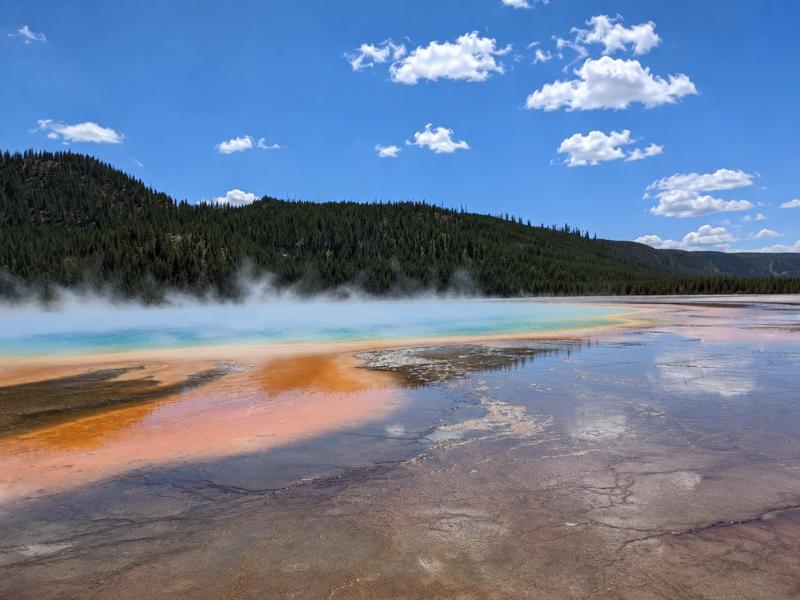
Why combine Yellowstone and Grand Teton in one trip?
The two parks sit 10 miles apart at their closest boundary, share the same ecosystem, and offer fundamentally different landscapes: Yellowstone delivers thermal features, wildlife corridors, and volcanic geology, while Grand Teton delivers the most dramatic mountain skyline in the lower 48, pristine alpine lakes, and the Snake River corridor. Visiting one without the other means missing half of what the Greater Yellowstone Ecosystem has to offer.
The difference in character is immediate. Yellowstone is a plateau, broad valleys and rolling forest at 7,000 to 8,000 feet, where the drama comes from what's happening underground (geysers, hot springs, fumaroles). Grand Teton is vertical. The Teton Range rises 7,000 feet above the valley floor in a single dramatic fault-block uplift, with no foothills to soften the transition. The visual impact of driving south from Yellowstone's rolling thermal basins into the sudden wall of the Tetons is one of the strongest landscape contrasts in any national park trip.
| Feature | Yellowstone | Grand Teton |
|---|---|---|
| Primary landscape | Volcanic plateau, thermal basins, wide valleys | Fault-block mountain range, alpine lakes, river corridors |
| Signature sights | Old Faithful, Grand Prismatic Spring, Lamar Valley, Grand Canyon of the Yellowstone | Teton Range, Jenny Lake, Snake River, Schwabacher Landing |
| Wildlife | Bison, wolves, grizzly bears (open valley viewing) | Moose, elk, bears, bald eagles (forest and river habitat) |
| Water | Yellowstone Lake, rivers, thermal pools | Jenny Lake, Leigh Lake, Snake River (floatable) |
| Activities | Boardwalk thermal viewing, wildlife watching, hiking | Lake kayaking, Snake River float/raft, mountain hiking, photography |
| Elevation | 6,000-8,000 ft (plateau) | 6,800 ft (valley) to 13,775 ft (Grand Teton summit) |
Wildlife viewing in the two parks differs in kind, not just in species. Yellowstone's Lamar Valley provides long-distance viewing across open grassland, ideal for wolf watching and bison herds. Grand Teton's Willow Flats and Oxbow Bend provide close-range viewing in riparian habitat, where moose stand in willow thickets and bald eagles hunt from cottonwood perches along the river. Combining both parks gives you both viewing styles in a single trip.
How many days do you need for a combined Yellowstone and Grand Teton trip?
Four days is the minimum for a meaningful combined trip. Five days is the sweet spot, giving you three full days in Yellowstone, one full day in Grand Teton, and a flex day for weather, a river float, or a longer hike. Trying to combine both parks in three days or fewer means giving one park a drive-through treatment, which shortchanges it.
| Trip length | Yellowstone days | Grand Teton days | What's realistic |
|---|---|---|---|
| 3 days | 2 | 0.5-1 (drive-through) | Grand Teton gets a scenic drive and maybe one stop. Not recommended for anyone who cares about both parks. |
| 4 days | 2.5-3 | 1-1.5 | Covers Yellowstone's top thermal features + one wildlife morning, plus Jenny Lake, a Snake River overlook, and possibly a short hike in the Tetons. |
| 5 days | 3 | 1.5-2 | Full Yellowstone loop + a proper Grand Teton day with a float or lake activity. Room for a weather buffer. |
| 6 days | 3-4 | 2 | Deep Yellowstone (including backcountry or repeated wildlife sessions) plus Grand Teton with multiple activities. |
The guided tours we work with map cleanly onto these timelines. The 4-day camping tour from Salt Lake City covers both parks in four days by entering through Grand Teton from the south and working northward into Yellowstone. The 5-day hotel-based tour runs Bozeman to Jackson, covering Yellowstone first and ending with Grand Teton and Jackson Hole. Both formats work. The difference is whether you see the Tetons first (southern entry) or as a finale (northern entry). Most travelers prefer the northern-entry format because the Teton reveal after three days of Yellowstone's plateau landscape hits harder when the mountains appear suddenly.
For a detailed day-by-day breakdown of how to plan each trip length, see our Yellowstone itinerary planning guide.
Which combined Yellowstone and Grand Teton tours are available?
Three operators we work with run tours that explicitly combine Yellowstone and Grand Teton: Bindlestiff Tours (both a 4-day camping and 5-day hotel option), and BrushBuck Wildlife Tours (a 4-day wildlife-focused tour from Jackson Hole that covers both parks). Each approaches the pairing differently.
| Tour | Days | Operator | Price (from) | Rating | Booked | Lodging | Route |
|---|---|---|---|---|---|---|---|
| 4-Day Camping from SLC | 4 | Bindlestiff Tours | ~$1,050 | 4.9 | 429+ | Camping | Salt Lake City north through Grand Teton into Yellowstone |
| 5-Day Hotel In-Depth | 5 | Bindlestiff Tours | ~$2,995 | 5.0 | 170+ | Hotel | Bozeman south through Yellowstone, ending in Jackson via Grand Teton |
| Wildlife Adventure 4 Days | 4 | BrushBuck Wildlife Tours | ~$2,198 | 4.8 | 363+ | Hotel | Jackson Hole into Grand Teton and Yellowstone, returning to Jackson |
The key differences go beyond price. The 4-day camping tour at around $1,050 is the most affordable combined option but involves sleeping in tents (gear provided, except sleeping bags), cooking communal meals from an $80 food kitty, and a maximum group size of 14. The hikes are 2 to 5 miles, making it accessible to reasonably active adults and children age 7 and up. With 429+ bookings and a 4.9 rating on TourRadar, it's the most-booked Yellowstone package among the operators we work with.
The 5-day hotel tour at around $2,995 is the premium option: hotel lodging every night, a wolf-tracking expert on the guide team, four breakfasts included, a $100 food kitty for other meals, and a 13-person maximum group. The extra day and the one-way Bozeman-to-Jackson routing mean more ground covered without doubling back. With a perfect 5.0 rating across 170+ bookings, it's the highest-rated tour in the set.
The BrushBuck Wildlife Adventure at around $2,198 is the wildlife-focused middle ground: 4 days, hotel lodging, a naturalist guide with binoculars and spotting scope, departing from Jackson Hole. The wildlife emphasis means more time in Lamar Valley and Willow Flats (Grand Teton's best moose habitat) and less time on thermal features compared to the Bindlestiff tours. At 4.8 with 363+ bookings, it's the strongest option for visitors whose primary draw is animals rather than geysers.
What does Grand Teton add that Yellowstone alone doesn't offer?
Grand Teton adds three things Yellowstone cannot provide: a dramatic mountain skyline visible from nearly every point in the park, the Snake River as a floatable and raftable waterway, and moose habitat (Willow Flats, Oxbow Bend) that's substantially better than anything inside Yellowstone's boundaries.
The Teton Range is the visual centerpiece. Unlike most mountain ranges, the Tetons have no western foothills. The range rises directly from the flat valley floor of Jackson Hole in a single fault-block wall, creating a skyline that dominates every view from the east side of the park. On a clear morning, the reflection of the peaks in the Snake River at Schwabacher Landing is one of the most photographed scenes in the American West.
| Experience | Available in Yellowstone? | Available in Grand Teton? | Notes |
|---|---|---|---|
| Geyser / thermal basins | Yes (world's largest concentration) | No | Yellowstone only |
| Wolf watching | Yes (Lamar Valley) | Rare | Yellowstone is the primary venue |
| Moose viewing | Possible but uncommon | Yes (Willow Flats, Oxbow Bend) | Grand Teton is significantly better for moose |
| Mountain skyline photography | Limited (no comparable range) | Yes (Teton Range) | Grand Teton only |
| Snake River float / rafting | No | Yes (scenic floats and whitewater sections) | Grand Teton only |
| Alpine lake access (kayaking, swimming) | Yellowstone Lake (large, cold) | Jenny Lake, Leigh Lake, String Lake (intimate, mountain-backed) | Both, but different character |
| Mountain hiking | Some (Mt. Washburn, Fairy Falls) | Extensive (Cascade Canyon, Lake Solitude, Paintbrush Divide) | Grand Teton is stronger for mountain hiking |
The Snake River float deserves its own paragraph because it's the single activity that most visitors cite as a Grand Teton highlight, often above the hiking and photography. A scenic float from Schwabacher Landing or Deadman's Bar covers a calm stretch of the river where the Tetons fill the western skyline, bald eagles nest in riverside cottonwoods, and moose occasionally wade through the shallows. The G Adventures Camping Explorer includes both a scenic Snake River float and a whitewater rafting section as standard itinerary elements, not optional add-ons.
Camping or hotel: which combined tour format is better?
Camping puts you closer to the parks (inside or adjacent, with campfire evenings under dark skies). Hotels give you a shower, a real bed, and a restaurant each night. The experience of the daytime itinerary is similar on both formats. The difference is how you spend your evenings and how you feel each morning.
| Factor | Camping tours | Hotel tours |
|---|---|---|
| Evening experience | Campfire, communal cooking, dark skies, wildlife sounds at night | Restaurant dinner, hot shower, climate-controlled room |
| Morning readiness | Pack up camp before departure; takes 30-60 minutes | Walk out of your room; departure is faster |
| Gear needed | Sleeping bag (not provided), warm layers for cold nights | Standard travel clothing only |
| Price range | Around $1,050 for 4 days (Bindlestiff camping) | Around $2,198 to $2,995 for 4-5 days |
| Physical demand | Moderate: camp setup + 2-5 mile hikes | Light to moderate: walking at viewpoints, some hikes |
| Weather vulnerability | Rain or cold affects sleep quality | Weather affects only daytime activities |
| Atmosphere | Immersive, outdoorsy, communal | Comfortable, private, social at meals |
The camping format at around $1,050 for four days is roughly half the cost of the hotel format at around $2,198 to $2,995 for four to five days. But the cost comparison isn't pure savings: camping tours provide gear (tents, sleeping pads, cooking equipment) and a food kitty handles meals communally, so the "included" list is different, not smaller. The real question is whether you want to fall asleep hearing coyotes in the distance or a thermostat clicking on.
For first-time visitors unsure which format suits them, the camping tour is the better test. If you discover you love waking up inside the park at dawn with the smell of campfire coffee, you'll know for future trips. If you discover you need a hot shower and a mattress to enjoy a vacation, the hotel tours exist for exactly that reason.
What are the best hikes in Grand Teton for combined-trip visitors?
Cascade Canyon is the signature Grand Teton day hike: a boat shuttle across Jenny Lake cuts the approach, and the trail follows a glacier-carved canyon between the peaks with views that improve with every mile. For visitors on a combined trip with limited Grand Teton time, it's the single best use of a hiking day.
The hike to Inspiration Point (a shorter option at roughly 2 miles round trip from the Jenny Lake boat dock) gives a high vantage over the lake and the valley floor without committing to a full canyon traverse. For families with younger children or visitors saving their legs after multiple Yellowstone hiking days, Inspiration Point delivers a strong Grand Teton experience in under two hours of trail time.
| Hike | Distance (round trip) | Elevation gain | Time | Highlights |
|---|---|---|---|---|
| Cascade Canyon (via boat shuttle) | ~9 miles | ~1,100 ft | 4-6 hours | Glacier-carved canyon, waterfalls, wildflowers, moose sightings common |
| Inspiration Point (via boat shuttle) | ~2 miles | ~420 ft | 1-2 hours | Panoramic view of Jenny Lake and Jackson Hole valley |
| Taggart Lake | ~3 miles | ~400 ft | 1.5-2.5 hours | Easy lake approach with full Teton Range reflection, good for photography |
| Delta Lake (unofficial trail) | ~7.5 miles | ~2,300 ft | 5-7 hours | Turquoise glacial lake at the base of the Grand Teton, steep and strenuous |
| Phelps Lake (via Death Canyon trailhead) | ~4 miles | ~500 ft | 2-3 hours | Quieter lake, bear habitat, fewer crowds than Jenny Lake area |
Guided tour itineraries rarely include a full Cascade Canyon hike because it requires half a day that most operators allocate to scenic driving and wildlife viewing instead. If Cascade Canyon is a priority, self-driving the Grand Teton portion of your trip, or choosing a tour with a flexible day that allows a personal hike, is the better approach. The G Adventures Camping Explorer includes a Mt. Washburn hike in Yellowstone and a Snake River float in Grand Teton, but individual hike selections within Grand Teton are typically at the guide's discretion based on group fitness and interest.
What wildlife is unique to Grand Teton compared to Yellowstone?
Moose are the marquee Grand Teton species. The park's willow-lined rivers and beaver ponds create ideal moose habitat, and sightings are more frequent and closer-range than in Yellowstone. Bald eagles are also more visible along the Snake River corridor, and the park's elk herd (the Jackson Elk Herd, one of the largest in North America) concentrates in the valley during spring and fall migrations.
The viewing style is different too. Yellowstone wildlife watching is typically long-distance, across wide valleys, through a spotting scope. Grand Teton wildlife watching often happens at close range: a moose standing in willows 50 yards from the road at Willow Flats, a bald eagle perched in a dead cottonwood above Oxbow Bend, a beaver working a dam at Schwabacher Landing at dusk. The intimacy of these encounters is part of what makes Grand Teton a valuable addition to a Yellowstone trip rather than a redundant one.
| Species | Grand Teton viewing quality | Best locations in Grand Teton | Comparison to Yellowstone |
|---|---|---|---|
| Moose | Excellent (close-range, frequent) | Willow Flats, Oxbow Bend, Schwabacher Landing, Moose-Wilson Road | Significantly better than Yellowstone for moose |
| Bald eagle | Very good (nesting along Snake River) | Oxbow Bend, Snake River corridor, Jenny Lake area | Comparable to Yellowstone Lake area, more concentrated |
| Elk | Seasonal: large herds in spring/fall | Valley floor, National Elk Refuge (winter) | Different pattern: Grand Teton has migration herds, Yellowstone has resident herds |
| Black bear | Good (especially Moose-Wilson Road corridor) | Moose-Wilson Road, Death Canyon trailhead area | Similar frequency to Yellowstone |
| Grizzly bear | Present but less visible than Yellowstone | Berry Creek area (backcountry), occasionally valley floor | Yellowstone has more frequent road-accessible sightings |
| Beaver | Excellent at dusk | Schwabacher Landing, beaver ponds along the Snake | More accessible and visible than Yellowstone |
The BrushBuck Wildlife Adventure explicitly builds Grand Teton's Willow Flats and Oxbow Bend into its itinerary for moose and raptor viewing, making it the strongest choice for visitors who want both parks' wildlife as a unified experience rather than as two separate stops on a driving tour.
What's the best time of year for a combined Yellowstone and Grand Teton trip?
Late June through mid-September is the prime window when all roads in both parks are open, trails are snow-free, and river floats are running. September stands out as the single best month if you can time it: elk rut, fall colors beginning in the Tetons, thinner crowds, and dramatic photography light.
| Month | Yellowstone highlights | Grand Teton highlights | Combined trip rating |
|---|---|---|---|
| May | Bears emerging, some roads still closed | Snow on peaks, limited high trails, rivers high | Good for Yellowstone wildlife; Grand Teton limited by snow |
| June | Wolf pups, bison calves, all roads opening | Wildflowers, snowmelt waterfalls, rivers running high | Excellent for wildlife and water; some higher trails still snowy |
| July | Peak visitor season, all facilities open | Full trail access, warm lake swimming, rafting season | Best logistics, worst crowds |
| August | Bison rut begins, crowds steady | Warm days, clear skies, all activities running | Strong; book 6+ months ahead |
| September | Elk rut, bears feeding heavily, fewer visitors | Fall colors (aspens), elk migration, photography light | Best overall: fewer crowds, strong wildlife, beautiful light |
| October | Some roads closing, elk rut continues | Peak fall color, cold mornings, some closures | Good but check road status weekly |
One logistics note for combined trips: the road connecting Yellowstone's South Entrance to Grand Teton opens in mid-May and closes in early November (exact dates vary by snowfall). If your trip falls near either end of that window, confirm the road status before committing to a combined itinerary, because a closure forces a multi-hour detour through gateway towns outside both parks.
Most guided tours schedule their combined Yellowstone-Grand Teton departures within the safe window (June through September) and don't run departures during the shoulder periods when the connecting road might close. That built-in seasonal awareness is another advantage of booking a guided tour over planning a self-drive trip in an uncertain month.
How do you get between Yellowstone and Grand Teton?
The two parks are connected by the John D. Rockefeller Jr. Memorial Parkway, a short stretch of road between Yellowstone's South Entrance and Grand Teton's northern boundary. The drive from Old Faithful (central Yellowstone) to Jenny Lake (central Grand Teton) takes roughly 1.5 to 2 hours depending on traffic, bison jams, and construction.
The transit between Yellowstone and Grand Teton is part of a combined guided itinerary. Self-drivers use the Rockefeller Parkway between the parks. The parks charge separate standard entrance fees; an eligible interagency pass can cover entrance, with residency rules and other charges to check.
The drive itself is not just transit. The road passes Yellowstone Lake's West Thumb Geyser Basin, Lewis Lake, and the Lewis River canyon before crossing into Grand Teton, where the Teton Range appears gradually through the forest and then suddenly dominates the western horizon. Several pullouts along this stretch offer views that warrant a 10-minute stop even on a tight schedule.
For travelers arriving by air, Jackson Hole Airport (JAC) is inside Grand Teton National Park, making it the most convenient arrival point for a combined trip that starts with the Tetons and ends in Yellowstone. Bozeman Airport (BZN) is the best arrival for trips that start with Yellowstone's northern range and work south. The 5-day hotel tour runs Bozeman to Jackson, so you fly into one and out of the other, covering maximum ground without backtracking.
To compare all combined packages and find the right one for your dates and budget, browse Yellowstone tour packages on our homepage. For a wider look at bus tour options including tours that go beyond both parks to Devils Tower and Mount Rushmore, that guide covers the full range.